
BIST GEO Index 2026: Are Borsa Istanbul Companies' Websites Ready for AI?
TL;DR
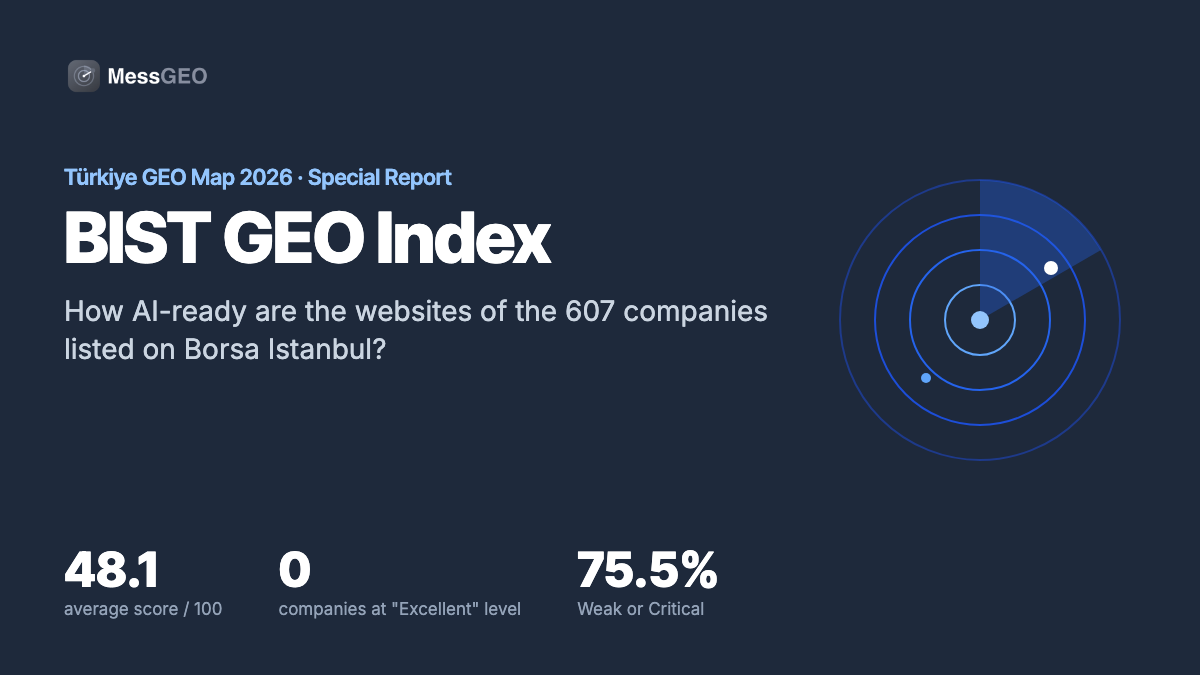
The BIST GEO Index 2026 is MessGEO's study of how ready the websites of the 607 companies listed on Borsa Istanbul are for AI assistants. The 538 websites we could analyse average 48.1 out of 100 on the AI-Readiness Score, against 47.8 for business websites across Türkiye scanned the same day. No company reaches "Excellent" and 75.5% sit at "Weak" or "Critical"; the BIST 30 average is 47.6. 95% link to an investor relations page, but only 26.5% carry Organization schema. 68 company websites did not open to an automated reader. The most AI-ready company is Lokman Hekim (83).
The report in one sentence: the websites of companies listed on Borsa Istanbul are no more ready for AI than the typical business website in Türkiye (48.1 against 47.8 out of 100), and the BIST 30 average is 47.6 (MessGEO, BIST GEO Index 2026, November 2026).
Key figures at a glance
| Item | Value |
|---|---|
| Scope | 607 companies traded on the Borsa Istanbul equity market (KAP list, 5 November 2026) |
| Websites analysed | 538 (68 of the 606 companies with a website on KAP did not open) |
| Average AI-Readiness Score | 48.1 out of 100 |
| Türkiye overall (same day, same measure) | 47.8 (825 business websites) |
| Companies at "Excellent" | 0 |
| Companies at "Strong" | 29 (5.4%) |
| Websites at "Weak" or "Critical" | 75.5% |
| BIST 30 average | 47.6 (25 websites) |
| Most AI-ready sector | Metal goods, machinery and automotive (52.0) |
| Least AI-ready sector | Food and beverage (44.9) |
| Highest score | Lokman Hekim, 83 |
| Scan date | 5 November 2026 |
Key findings
- 607 companies, 538 websites analysed. The average AI-Readiness Score is 48.1 out of 100. Business websites across Türkiye, scanned the same day with the same measure, average 47.8; the difference is within the margin of error.
- No company reaches "Excellent". 29 companies (5.4%) are at "Strong"; 75.5% of websites sit at "Weak" or "Critical".
- Size makes no difference. BIST 30 companies average 47.6, the rest of the BIST 100 49.6, and companies outside the BIST 100 47.9.
- Investor pages, yes. An introduction for AI, no. 95% of websites link to an investor relations page; only 26.5% carry Organization schema, and just 4 state their ticker symbol in it.
- 68 company websites did not open to an automated reader. 41 of them have a security certificate or secure connection problem; 19 serve an incomplete certificate chain.
- A 7-point gap between sectors. Metal goods, machinery and automotive lead with 52.0; food and beverage trail with 44.9.
- Every sector has good examples. In food and beverage, Türk Tuborg scores 78, 33 points above its sector average; the top three in each of the 11 sectors with at least 20 companies are listed in this report.
What is the BIST GEO Index, and what does the AI-Readiness Score measure?
The BIST GEO Index is MessGEO's study of the corporate websites of companies traded on Borsa Istanbul, seen through the eyes of AI assistants. Its unit of measurement is the AI-Readiness Score: a score out of 100 that summarises how far a website meets the basic conditions assistants such as ChatGPT, Gemini, Copilot and Perplexity need to find it, read it and describe it accurately. A high score means the website is an open, readable source that makes clear who the company is; a low score means an assistant has to turn to other, often less reliable, sources to work out who the company is.
The score places websites on five levels: A "Excellent", B "Strong", C "Room to grow", D "Weak" and F "Critical". GEO (Generative Engine Optimization) is the work that raises this score: making the information on a company's own website something AI can read and trust.
This report does not measure how AI currently describes a company. It measures whether the company's website provides the basic information needed for it to be described correctly.
Why it matters for listed companies
Investors, journalists, customers and job seekers no longer look a company up only in a search engine. They also ask AI assistants such as ChatGPT, Gemini, Copilot, Perplexity, Google AI Overviews and Google AI Mode: "What does this company do?", "Which sector is it in, and who are its competitors?", "Is it listed, and what is its ticker?" In a survey of 11,000 retail investors in 13 countries, 19% said they use AI tools to pick or adjust investments in their portfolio, up from 13% a year earlier (eToro Retail Investor Beat, 2025).
To describe a company correctly, AI first has to recognise it: its full legal name, what it does, which exchange it trades on and under which ticker, and its official profiles. The only source of this information that the company fully controls is its own website. KAP filings, news coverage and third-party data sites complement that source but cannot replace it; if the website falls short, the assistant fills the gap from somewhere else.
Are BIST companies ahead of the rest of Türkiye?
No. The 538 company websites we could analyse average 48.1 out of 100 on the AI-Readiness Score. For comparison, we rescanned business websites picked at random from the Türkiye GEO Map on the same day and with the same measure as the BIST scan: the 825 websites we could analyse average 47.8. Both averages carry a margin of error of roughly ±1 point, so the 0.3-point difference is not statistically meaningful.
The level distribution of listed companies closely mirrors that of Türkiye as a whole:
| Level | Label | BIST companies | Türkiye overall |
|---|---|---|---|
| A | Excellent | 0% | 0% |
| B | Strong | 5.4% | 4.2% |
| C | Room to grow | 19.1% | 24.0% |
| D | Weak | 56.3% | 50.4% |
| F | Critical | 19.1% | 21.3% |
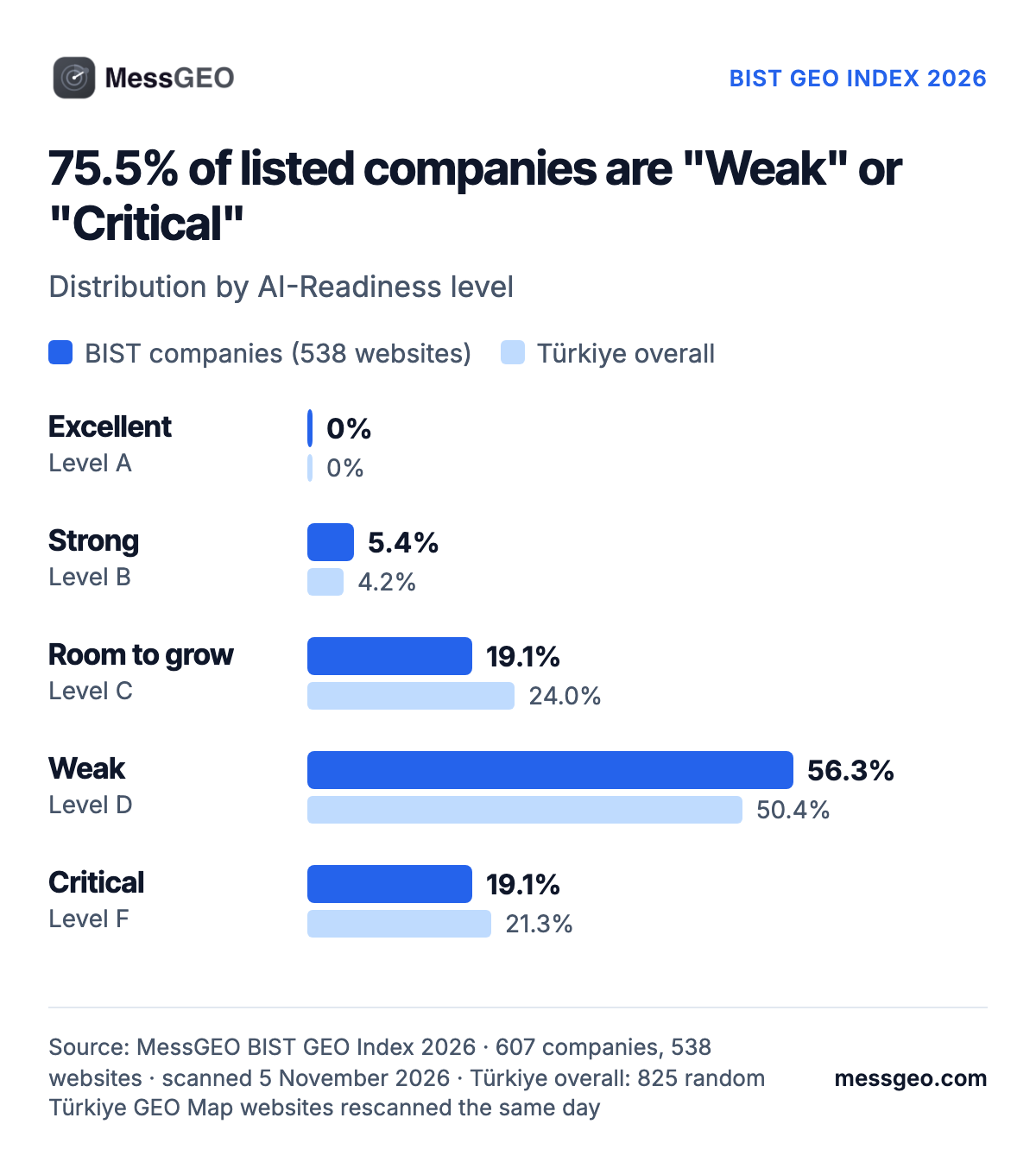
In other words, being listed, independently audited and subject to regular disclosure has not yet translated into a company's ability to explain itself to AI. 63.9% of the websites score below 50 out of 100.
Are BIST 30 companies more AI-ready?
No. We split the companies into three groups by index membership. The BIST 30, made up of the companies with the highest market value and trading volume, does not score higher than the other groups:
| Group | Companies | Websites analysed | Avg. score | At "Critical" |
|---|---|---|---|---|
| BIST 30 | 30 | 25 | 47.6 | 7 websites |
| BIST 100 (31-100) | 70 | 62 | 49.6 | 10 websites |
| Outside BIST 100 | 507 | 451 | 47.9 | 86 websites |
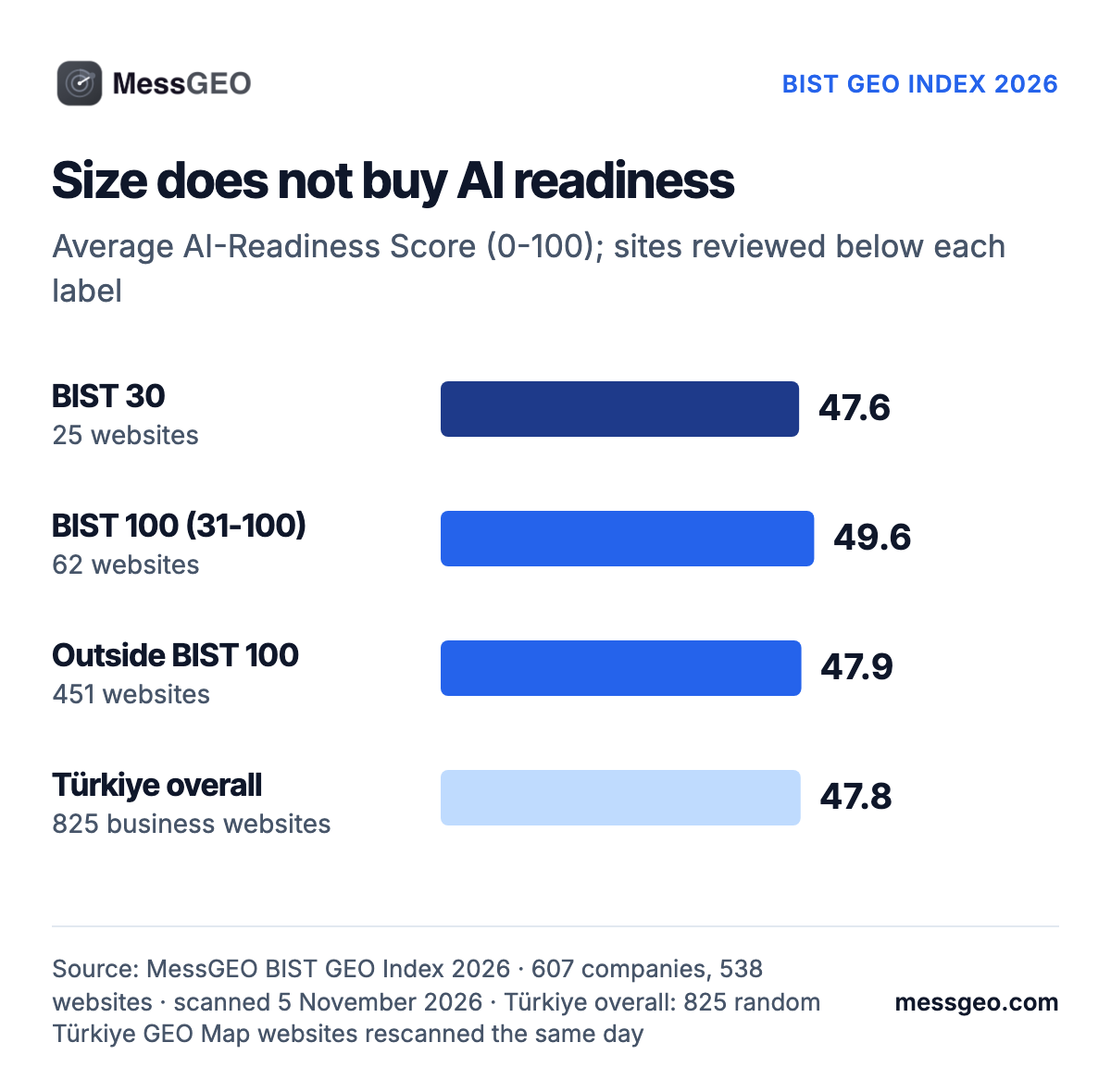
The differences between the groups are within the margin of error; with only 25 BIST 30 websites analysed, that group's average could move by a few points. What stands out is that the largest companies do not stand apart from the average.
The BIST 30 tells two stories. Of the 19 BIST 30 homepages we could review in full, 84.2% link to an English version and 31.6% carry Organization schema, both above the overall average. Yet the websites of 5 of the 30 companies did not open to an automated reader on scan day, and 7 of the 25 websites analysed sit at "Critical". Large companies' websites are often visually rich, but that richness does not turn into information AI can read.
Which sector is the most AI-ready?
Across the 11 sectors with at least 20 companies analysed, average scores range from 44.9 to 52.0. Sectors follow the classification used by the Public Disclosure Platform (KAP); we merged similar sub-sectors.
| Rank | Sector | Websites | Avg. score |
|---|---|---|---|
| 1 | Metal goods, machinery, automotive (incl. white goods) | 40 | 52.0 |
| 2 | Chemicals, petroleum, plastics | 46 | 51.5 |
| 3 | Technology, IT and telecoms | 45 | 49.3 |
| 4 | Energy | 37 | 49.0 |
| 5 | Cement, glass and ceramics | 26 | 48.6 |
| 6 | Retail and wholesale | 24 | 47.6 |
| 7 | Basic metals | 30 | 46.3 |
| 8 | REITs | 48 | 45.5 |
| 9 | Holdings and investment | 43 | 45.5 |
| 10 | Textiles | 20 | 45.5 |
| 11 | Food and beverage | 41 | 44.9 |
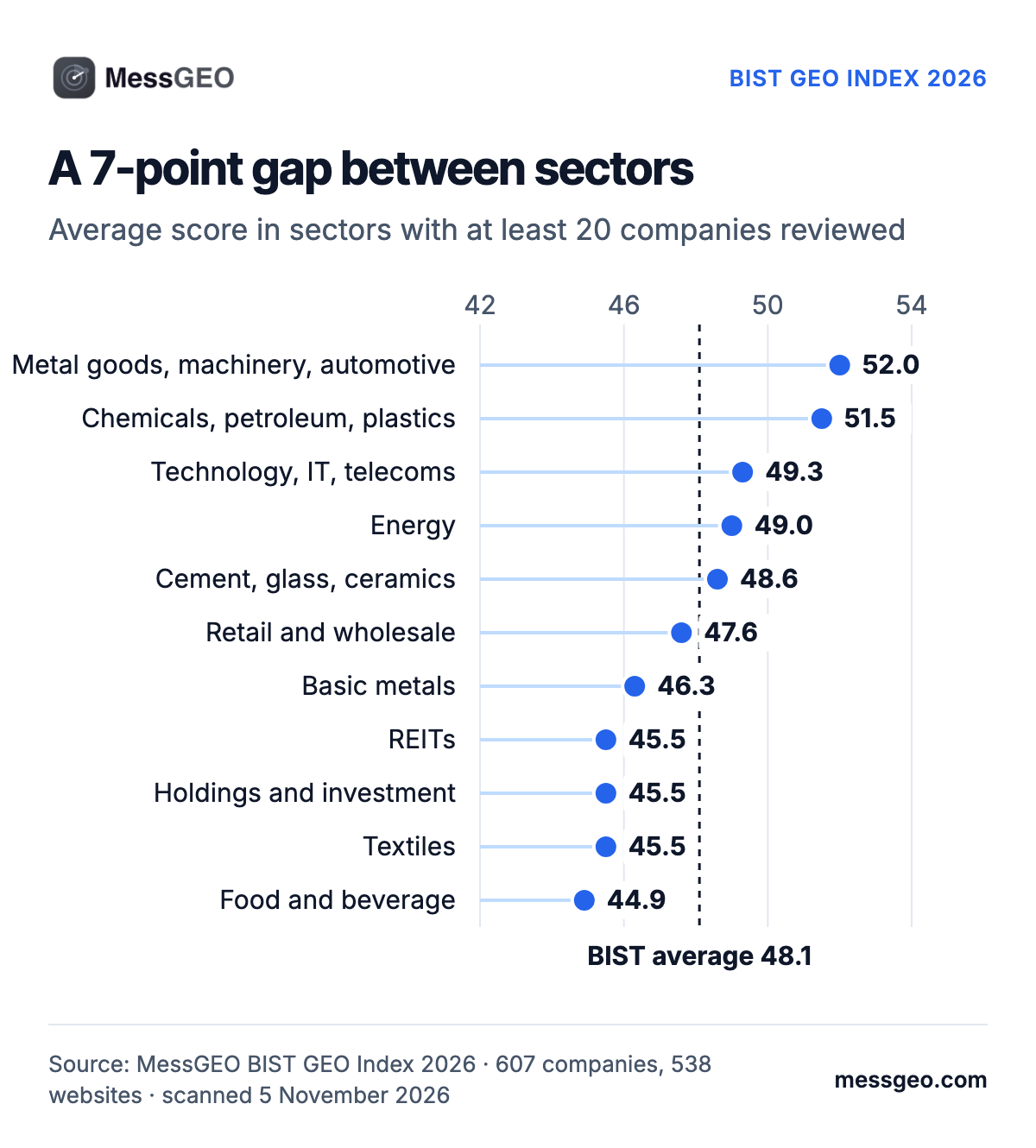
The spread matters as much as the average. Only 8.7% of chemicals, petroleum and plastics companies sit at "Critical", compared with 24.4% in food and beverage, 23.3% in holdings and investment, and 22.2% in technology and IT. Food and beverage, one of the sectors closest to consumers, comes last. Holdings and real estate investment trusts are also below average, even though the first thing anyone asks about them is exactly "what does this company do, and what does it own?" The bank, insurance and brokerage groups, each with fewer than 20 companies, average above the overall figure.
What is missing from listed companies' websites?
We reviewed in full the homepages of 475 company websites. Listed companies have largely built what a human reader needs; the layer that AI reads has wide gaps.
| On the homepage | Share |
|---|---|
| Link to an investor relations page | 95.2% |
| Link to an English version | 75.2% |
| Any structured data | 34.9% |
| Organization schema (Organization or Corporation) | 26.5% |
| Links to official profiles (sameAs) | 22.1% |
| llms.txt file | 13.3% |
| Legal name in schema (legalName) | 6.3% |
| Ticker symbol in schema (tickerSymbol) | 0.8% (4 websites) |
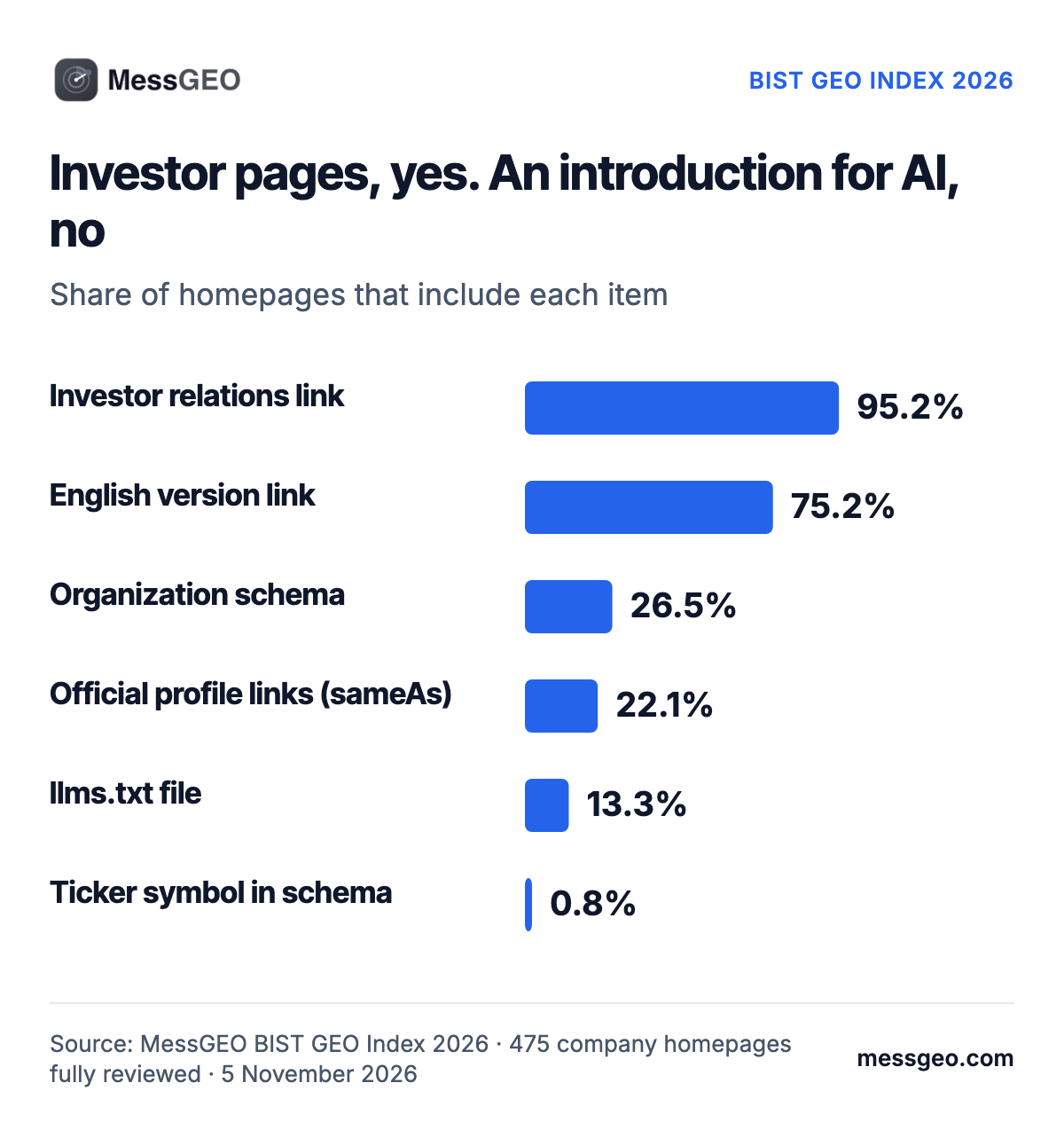
Organization schema and the ticker symbol
Organization schema is structured data added to a website's code that says "this website belongs to a company with this legal name, this address, this logo and these official profiles". Visitors do not see it; search engines and AI systems read it. 34.9% of the websites carry some form of structured data, but schema that introduces the company as an organisation appears on only 26.5%, about one in four. The ticker symbol, one of the most distinctive facts about a listed company, appears in the schema of just 4 of the 475 websites; 3 of them give the Borsa Istanbul ticker, and one gives the ticker of its foreign parent. 6.3% state their legal name in schema.
Wikidata: the open knowledge record
Wikidata is one of the open sources that search engines and AI systems consult for information about organisations. We found a Wikidata record matching the company's website for only 108 of the 607 companies (17.8%). The rate is high in the BIST 30 (25 of 30 companies). However, only 20 of the 607 companies, and 9 in the BIST 30, appear in Wikidata with a Borsa Istanbul listing and their ticker symbol.
English version and language tags
Foreign investors mostly ask their questions in English. About three in four websites link to an English version, which is a good rate. But the language of each page also has to be declared correctly in the code: of the 516 websites whose homepage HTML we could retrieve, 86 (16.7%) either have no language tag at all (57 websites) or the wrong one (29 websites). On those 29 websites the page is in Turkish but the code says "English", usually a leftover default from an off-the-shelf theme, which tells AI the wrong language.
llms.txt
llms.txt is a new file format that gives AI a short summary of a website and a list of its key pages. 13.3% of the homepages we reviewed in full publish one; in the BIST 30, 6 of the 19 fully reviewed homepages do. In at least 8 of the published files, Turkish characters appear corrupted or missing: the file is there, but it gives the reader the wrong text.
Which websites did not open to an automated reader, and why?
Of the 606 companies with a website listed on KAP, 68 (11.2%) had websites that did not open at all to an automated reader (the kind of client used by AI and search bots) on scan day. These websites are not included in the averages. Most of the causes are technical and easy to fix:
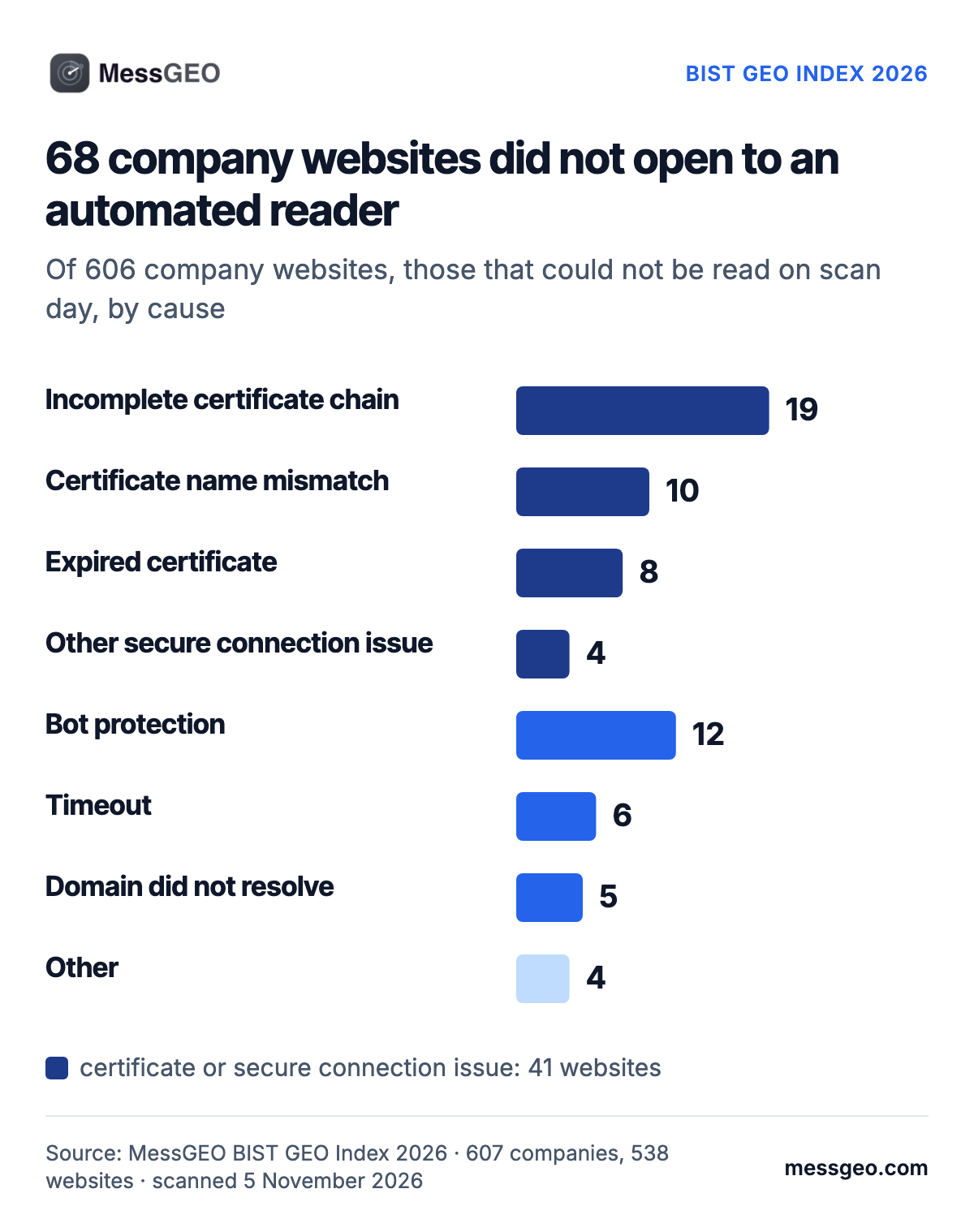
- Incomplete certificate chain (19 websites). A website's security certificate should be served together with the "intermediate certificate" that vouches for it. If the server does not send that intermediate certificate, the chain is incomplete. Browsers usually fill in the missing link themselves, so the website opens normally for human visitors; many automated readers do not, and drop the connection as untrusted. That is why the problem is hard to spot.
- Certificate name mismatch (10 websites). The address listed on KAP differs from the address the certificate covers; for example, the certificate covers only "company.com.tr" while KAP lists "www.company.com.tr".
- Expired certificate (8 websites).
- Other secure connection issues (4 websites), bot protection (12), timeouts (6), domains that did not resolve (5) and other errors (4).
Bot protection can be a deliberate security choice; but if it also stops the readers used by AI assistants, the company has closed off its own chance to explain itself to AI.
Invisible content: text on the screen, but not in the code
On 42 of the 538 websites analysed (7.8%), the homepage text is missing or very thin in the raw HTML: it only appears once a browser loads it. This matters because the crawlers behind assistants such as ChatGPT, Claude and Perplexity do not execute JavaScript, while Gemini can, thanks to Googlebot's infrastructure (Vercel, December 2024). In the BIST 30, 3 websites are in this position.
Few companies block AI bots
Of the 430 websites with a robots.txt file, 34 (7.9%) block the bots that collect data to train AI models (GPTBot, ClaudeBot, Google-Extended). On 31 of those 34 websites, the block comes from Cloudflare's one-click managed robots.txt feature: a bundled setting rather than a bot-by-bot decision. Only 1 website blocks the bots that read a site while answering a user's question. So the problem is not blocking: the door is open, but there is little inside that AI can read.
Which are the 11 most AI-ready listed companies?
These 11 companies score 74 or higher on the AI-Readiness Score, all at the "Strong" level (ties ordered by ticker):
| Rank | Company | Ticker | Score |
|---|---|---|---|
| 1 | Lokman Hekim | LKMNH | 83 |
| 2 | Bak Ambalaj | BAKAB | 78 |
| 2 | Kuzey Boru | KBORU | 78 |
| 2 | Türk Tuborg | TBORG | 78 |
| 5 | CW Enerji | CWENE | 75 |
| 6 | Birleşim Mühendislik | BRLSM | 74 |
| 6 | Egeplast | EPLAS | 74 |
| 6 | Gen İlaç | GENIL | 74 |
| 6 | Mercan Kimya | MERCN | 74 |
| 6 | Orzaks İlaç | ORZAX | 74 |
| 6 | Sabancı Holding | SAHOL | 74 |
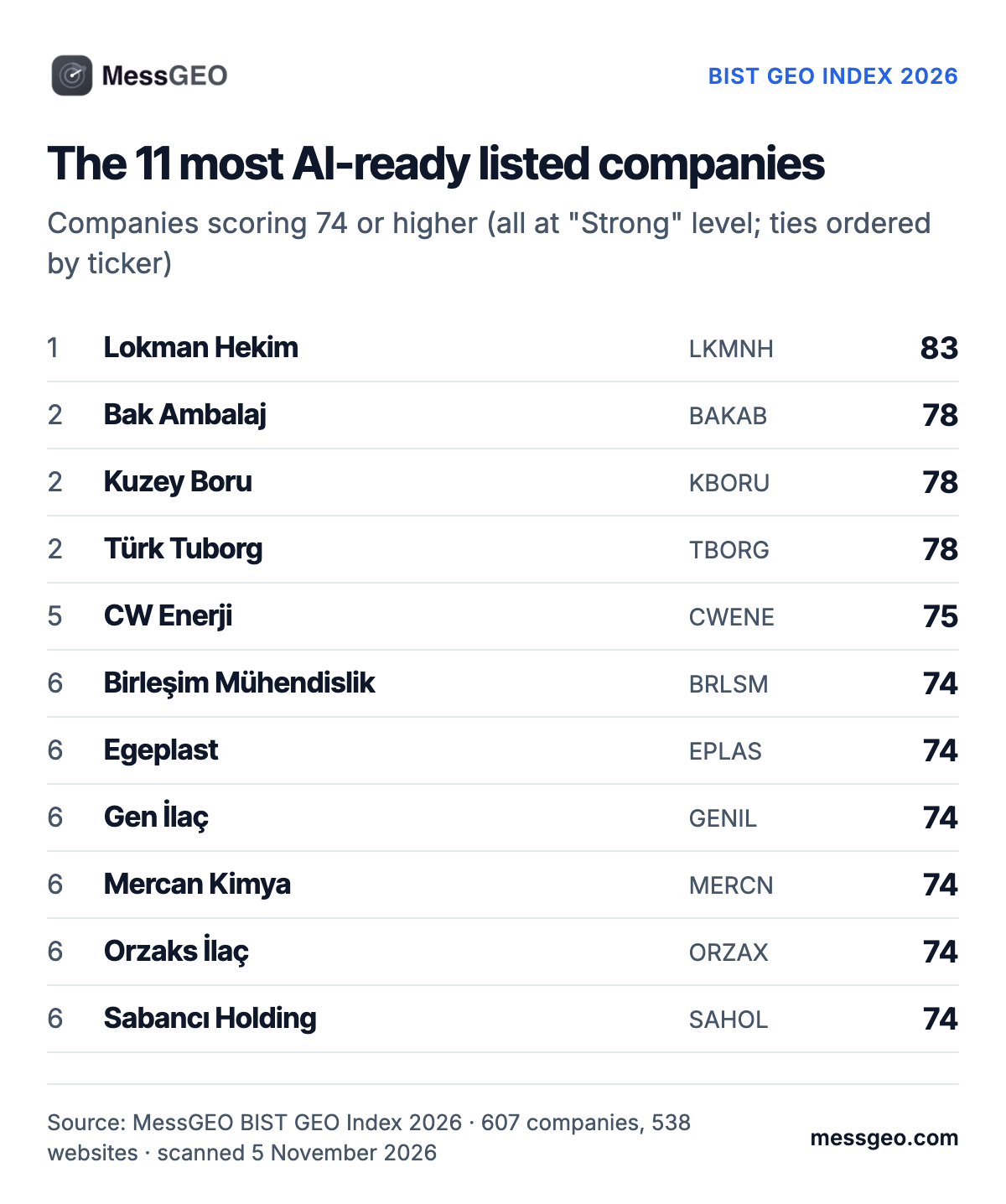
The most striking feature of the list is that 9 of the 11 companies come from outside the BIST 100. Sabancı Holding represents the BIST 30, and CW Enerji the rest of the BIST 100. Scores reflect the measurement of 5 November 2026; rankings change as websites change.
Sector leaders: the most AI-ready companies in each sector
The overall picture is weak, but every sector has good examples. Below are the top three companies by AI-Readiness Score in each of the 11 sectors with at least 20 companies analysed; companies with equal scores are all listed, ordered by ticker. Sectors follow the KAP classification; Gen İlaç, for example, is listed under wholesale trade on KAP and therefore appears in retail and wholesale. Restaurant chains sit under hotels and restaurants on KAP, a group with fewer than 20 companies, so it is not in the table; the bank, insurance and brokerage groups are left out for the same reason.
| Sector | Websites analysed | 1st (score) | Next (score) |
|---|---|---|---|
| Metal goods, machinery, automotive | 40 | Makina Takım (73) | Tümosan (71), Alarko Carrier (70), Türk Prysmian Kablo (70) |
| Chemicals, petroleum, plastics | 46 | Kuzey Boru (78) | Egeplast (74), Mercan Kimya (74), Orzaks İlaç (74) |
| Technology, IT and telecoms | 45 | Matriks (71) | Forte Bilgi İletişim (69), Logo Yazılım (68) |
| Energy | 37 | CW Enerji (75) | Masfen Enerji (73), Birleşim Grup Enerji (72) |
| Cement, glass and ceramics | 26 | Albayrak Beton (71) | Çimsa (64), Çağdaş Cam (63) |
| Retail and wholesale | 24 | Gen İlaç (74) | Bizim Toptan (67), Migros (64) |
| Basic metals | 30 | Burçelik Vana (67) | BMS Çelik Hasır (62), Panelsan (61) |
| REITs | 48 | Koray GYO (67) | Akfen GYO (66), Reysaş GYO (64) |
| Holdings and investment | 43 | Sabancı Holding (74) | Güler Yatırım Holding (71), Global Yatırım Holding (71) |
| Textiles | 20 | Kordsa (66) | Yünsa (64), Desa (57) |
| Food and beverage | 41 | Türk Tuborg (78) | Penguen Gıda (67), Durukan Şekerleme (66) |
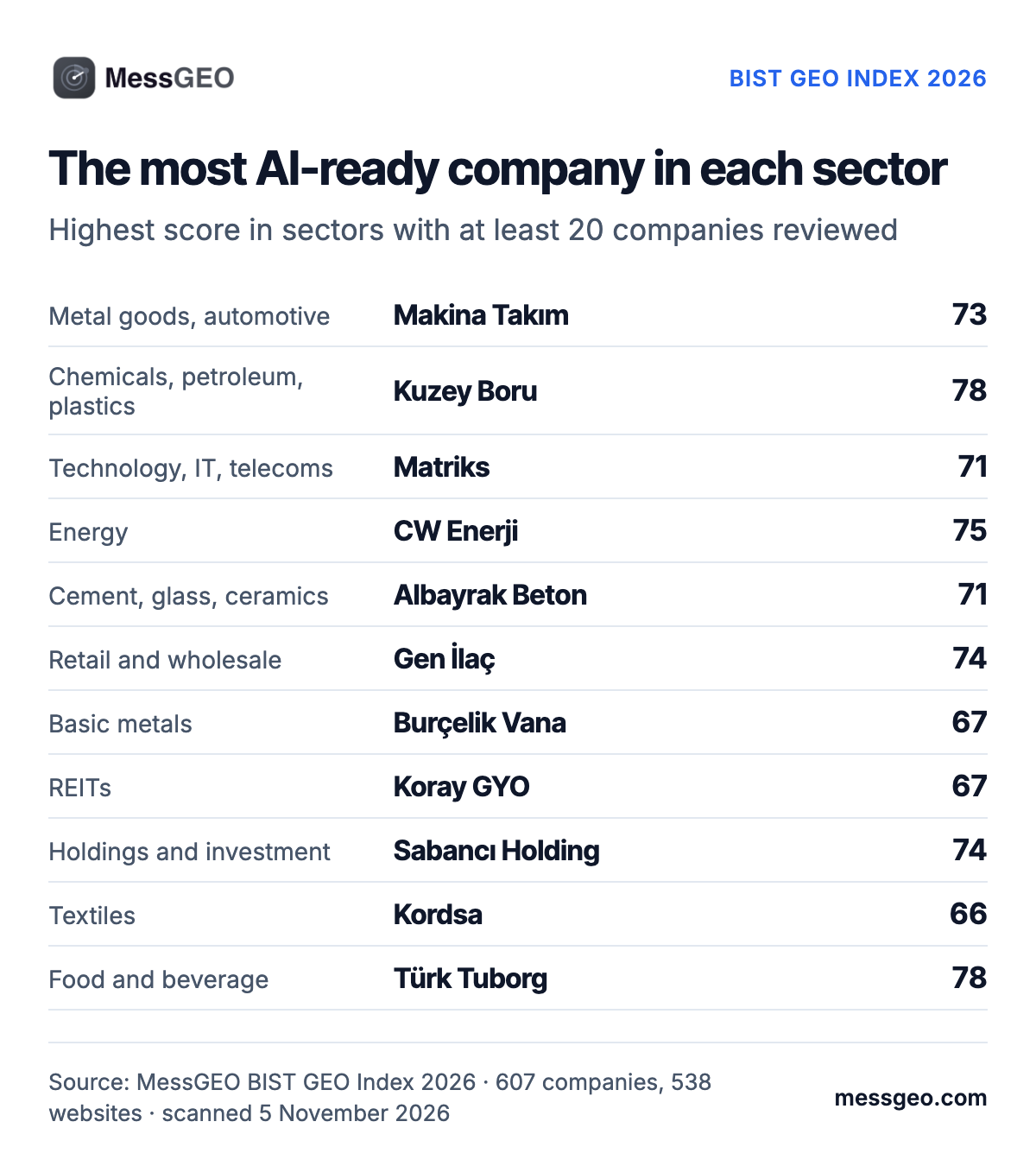
In some sectors the gap between the leader and the sector average is very wide. In food and beverage, Türk Tuborg scores 78 against a sector average of 44.9, a difference of 33 points. In REITs, basic metals and textiles, by contrast, no company reaches the "Strong" level; the leaders of these three sectors stop at 66 to 67 points. Scores reflect the measurement of 5 November 2026.
What this means for investors and investor relations teams
For investors: the answer you get when you ask an AI assistant about a company is only as good as the sources the assistant can reach. This report shows that three in four listed companies' websites sit at "Weak" or "Critical" for AI readiness, and that 68 did not open at all. Before basing an important decision on an AI summary, it is still worth checking the company's KAP filings and its own website.
For investor relations and corporate communications: the picture looks bleak, but the good news is that most of the gaps are not about website design. They come down to a few lines of code and server settings. Organization schema, the ticker symbol, a correct language tag, a complete certificate chain and a readable one-sentence description in the raw HTML are jobs most companies can complete in a short development cycle. With competitors in the same position, the companies that act early have a chance to stand out in their sector, and the sector leaders table shows it can be done.
On audit and compliance: this report contains no assessment of financial position, corporate governance or disclosure obligations. The only thing it measures is whether a company's own website can be read and identified by AI.
A 10-point checklist for investor relations and corporate communications teams
- Add Organization schema. Add structured data of type Organization (or Corporation) to your homepage: full legal name (legalName), logo, address, contact details, founding year and ticker symbol (tickerSymbol, for example "BIST: CODE").
- Link your official profiles in the schema. Add your KAP company page, LinkedIn, Wikipedia and Wikidata records to the sameAs field.
- Check your Wikidata record. If you have none, create one; if you do, make sure the official website, Borsa Istanbul listing and ticker symbol are correct.
- Test your certificate chain. Use a free SSL testing tool to confirm that your server also sends the intermediate certificate, and that the certificate covers both the "www" and the bare domain.
- Check the address listed on KAP. The first website address on KAP should be your main corporate website and match exactly the address your certificate covers and that actually opens.
- Add a one-sentence description to your homepage. For example: "[Legal name] is a [type of company] operating in [sector] since [year], traded on Borsa Istanbul under the ticker [CODE]."
- Declare the page language correctly. Turkish pages should say lang="tr" and English pages lang="en"; link the language versions with hreflang tags.
- Make sure your content is in the raw HTML. If the homepage text only loads in the browser, most AI bots cannot see it.
- Review your bot protection. Check whether your security layer also blocks the readers used by AI assistants, and make sure your robots.txt choices are deliberate.
- Back up your investor pages with text. Keep your business areas, subsidiaries and key figures out of PDF-only reports; give them short, readable text on the page as well. If you publish llms.txt, make sure it is served in UTF-8.
You can check your own company's website with the free AI-Readiness Score.
Related MessGEO reports
This report is one of the special reports of the Türkiye GEO Map 2026. Sector reports built on the same measure: the Restaurant GEO Report and the Hotel GEO Report. Our GEO guide explains what GEO is and where to start.
Methodology
- Scope: the 607 companies on the Public Disclosure Platform (KAP) list of Borsa Istanbul companies that trade on the Star Market, Main Market, Sub-Market or Watchlist Market of the equity market (5 November 2026). Companies traded only on the Surveillance Market or the Pre-Market Trading Platform, issuers of debt instruments only, funds and structured products are out of scope. Website addresses, index memberships and sectors were taken from each company's KAP summary page; 606 companies list a website on KAP. Where a company lists several addresses, we used the first; in one case where the first address was clearly a group website, we scanned the company's own website instead.
- Scan: the homepage of each company's website was scanned on 5 November 2026 with the quick version of the MessGEO AI-Readiness Score. 538 websites were analysed; 68 did not open on scan day and are excluded from the averages. Websites that did not open were tried at least twice, and certificate problems were confirmed separately with a different tool. Bot protection may behave differently depending on the client and the time.
- Close-up: Organization schema, ticker symbol, sameAs, investor relations and English version links were read from the HTML of the 475 homepages we could review in full; llms.txt and robots.txt files were read from the websites themselves. Wikidata records were matched through Wikidata's open query service, using the website address and the Borsa Istanbul listing; companies without a registered address may appear unmatched, so this rate is a lower bound.
- Comparison with Türkiye overall: the 44.6 average in the Türkiye GEO Map comes from the September to October 2026 scan. For a fair comparison, we rescanned 940 websites picked at random from the map on the same day and with the same measure as the BIST scan; 825 opened, averaging 47.8. Today's figure is higher than 44.6 for two reasons: the measuring tool has been updated since October (the same websites now score 1.3 points higher on average), and the websites that have become unreachable since then were ones that scored below average. Neither scan includes websites that did not open.
- Groups: index groups follow index membership on KAP (BIST 30, BIST 100). Sectors were merged from the KAP classification; only sectors with at least 20 companies analysed are shown, and catch-all "other" groups are left out. Two pairs of companies that share a website were counted separately.
- Naming rule: only the highest-scoring companies are named (the overall top 11 and the top three in each sector), with ties ordered by ticker. No company with a low score or a website that did not open is named.
- Limitations: the score measures how ready a website is for AI, not how AI currently describes the company, its financial position or its investment value. The quick scan looks only at the homepage; content on separate subdomains such as investor relations sites is not part of this measurement. This report is not investment advice.
- Independence: this study is not affiliated with Borsa Istanbul A.Ş. or KAP. BIST is a registered trademark of Borsa Istanbul A.Ş.; the "BIST GEO Index" is not an official exchange index but the name of an independent MessGEO study.
How to cite this report
MessGEO (2026). BIST GEO Index 2026. Türkiye GEO Map 2026, Special Report. https://messgeo.com/blog/bist-geo-index-turkiye/
You may use the figures and charts in this report with attribution.
Frequently asked questions
What is the BIST GEO Index?
The BIST GEO Index is an independent MessGEO study that measures how ready the corporate websites of companies traded on Borsa Istanbul are for AI assistants. The 2026 edition covers 607 companies; 538 websites were analysed and the average AI-Readiness Score came out at 48.1 out of 100. It is not an official exchange index and has no affiliation with Borsa Istanbul A.Ş. or KAP.
What is the AI-Readiness Score?
The AI-Readiness Score is MessGEO's measure, out of 100, of how far a website meets the basic conditions AI assistants such as ChatGPT, Gemini, Copilot and Perplexity need to find it, read it and describe it accurately. It places websites on five levels: A "Excellent", B "Strong", C "Room to grow", D "Weak" and F "Critical". It measures the groundwork needed for a company to be described correctly, not how AI currently describes it.
Are listed companies' websites ready for AI?
Most are not. In the 2026 measurement, 75.5% of the 538 listed company websites analysed sit at "Weak" or "Critical"; no company reaches "Excellent", and 29 are at "Strong". The average of 48.1 is no different from the 47.8 average of business websites across Türkiye measured the same day.
Are BIST 30 companies more AI-ready?
No. The 25 BIST 30 websites analysed average 47.6, against 49.6 for the rest of the BIST 100 and 47.9 for companies outside the BIST 100. The differences are within the margin of error. The websites of 5 BIST 30 companies did not open to an automated reader on scan day, and 7 sit at "Critical".
Which sector is the most AI-ready?
Among the 11 sectors with at least 20 companies analysed, metal goods, machinery and automotive rank first with 52.0, followed by chemicals, petroleum and plastics with 51.5. Food and beverage trail with 44.9. The gap between sector averages is 7 points.
Do investors really ask AI about companies?
Increasingly so. In a survey of 11,000 retail investors in 13 countries (eToro Retail Investor Beat, 2025), 19% said they use AI tools when picking or adjusting investments, up from 13% a year earlier. Journalists, analysts, customers and job seekers also ask AI about companies more and more often.
All our information is already on KAP. Why fix our own website?
KAP filings exist for legal disclosure and mostly come as documents. The company's own website is where it explains what it does in its own words, in a form AI can read easily. Organization schema on the website ties these sources together by linking to your KAP page and your other official profiles.
What is Organization schema?
Organization schema is structured data added to a website's code that gives the company's full legal name, logo, address, contact details, official profiles and, for listed companies, ticker symbol in a form machines can read. Visitors do not see it; search engines and AI systems read it. In the 2026 measurement, only 26.5% of listed companies had Organization schema on their homepage.
What is an incomplete certificate chain, and how do we know if we have one?
If your server sends its security certificate without the intermediate certificate that vouches for it, the chain is incomplete. The website opens normally in a browser, so the problem goes unnoticed, but many automated readers drop the connection. Free SSL testing tools report it as an "incomplete chain"; the fix is usually just adding the intermediate certificate to the server. In the 2026 measurement, the websites of 19 listed companies did not open for this reason.
What is llms.txt, and do listed companies need one?
llms.txt is a plain-text file placed in a website's root directory that gives AI a short company summary and a list of key pages. It is neither mandatory nor enough on its own, but together with a one-sentence description on the homepage and Organization schema it makes it easier for a company to explain itself. In the 2026 measurement, 13.3% of listed companies had published one; at least 8 of those files showed corrupted Turkish characters, which is why the file should be served in UTF-8.
Does it make sense to block AI bots?
Two kinds of bots need to be told apart. One kind collects data to train AI models; blocking it can be a legitimate choice. The other reads a website at the moment it answers a user's question; blocking it raises the risk that the company is described wrongly or incompletely in the answer. Very few listed companies block the second kind.
Why are only the most AI-ready companies named?
The aim of this report is to show the overall picture of the exchange, not to single out individual companies. That is why we name only the good examples, the overall top 11 and the top three in each sector; all other results are shared in aggregate.
How can we find out our company's score?
Enter your website address in the free AI-Readiness Score tool to see it within seconds. The free result is the same quick measure used in this report; a full scan includes additional checks, so its score may differ.