
Restaurant GEO Report 2026: Are Restaurant Websites Ready for AI?
TL;DR
The Restaurant GEO Report 2026 is the first sector report of the Türkiye GEO Map. The 9,431 restaurant websites we analysed in Türkiye have an average AI-Readiness Score of 40.5 out of 100, ranking last of 27 sectors. Nine in 10 sit at the "Weak" or "Critical" level, and not a single restaurant website reaches "Excellent". We also took a close look at 726 restaurant homepages: only 1 in 4 has restaurant schema, about 1 in 5 has opening hours, and fewer than 1 in 10 has menu information in a form AI can read.
The report in one sentence: 82.7% of the 9,431 restaurant websites in Türkiye score below 50 out of 100 on the AI-Readiness Score; with an average of 40.5, restaurants rank last of 27 sectors (MessGEO, Türkiye GEO Map 2026, October 2026).
Summary: how AI-ready are restaurant websites?
- 9,431 restaurant websites analysed. The average AI-Readiness Score is 40.5 out of 100, 4.1 points below the national average of 44.6.
- Last of 27 sectors. Restaurants are the furthest behind of all the sectors in the Türkiye GEO Map.
- Not a single restaurant website reaches "Excellent". Only 64 websites (0.7%) reach "Strong"; 89.4% are "Weak" or "Critical".
- The most common gap is structured data. It is the lowest-scoring area for 67.2% of restaurant websites.
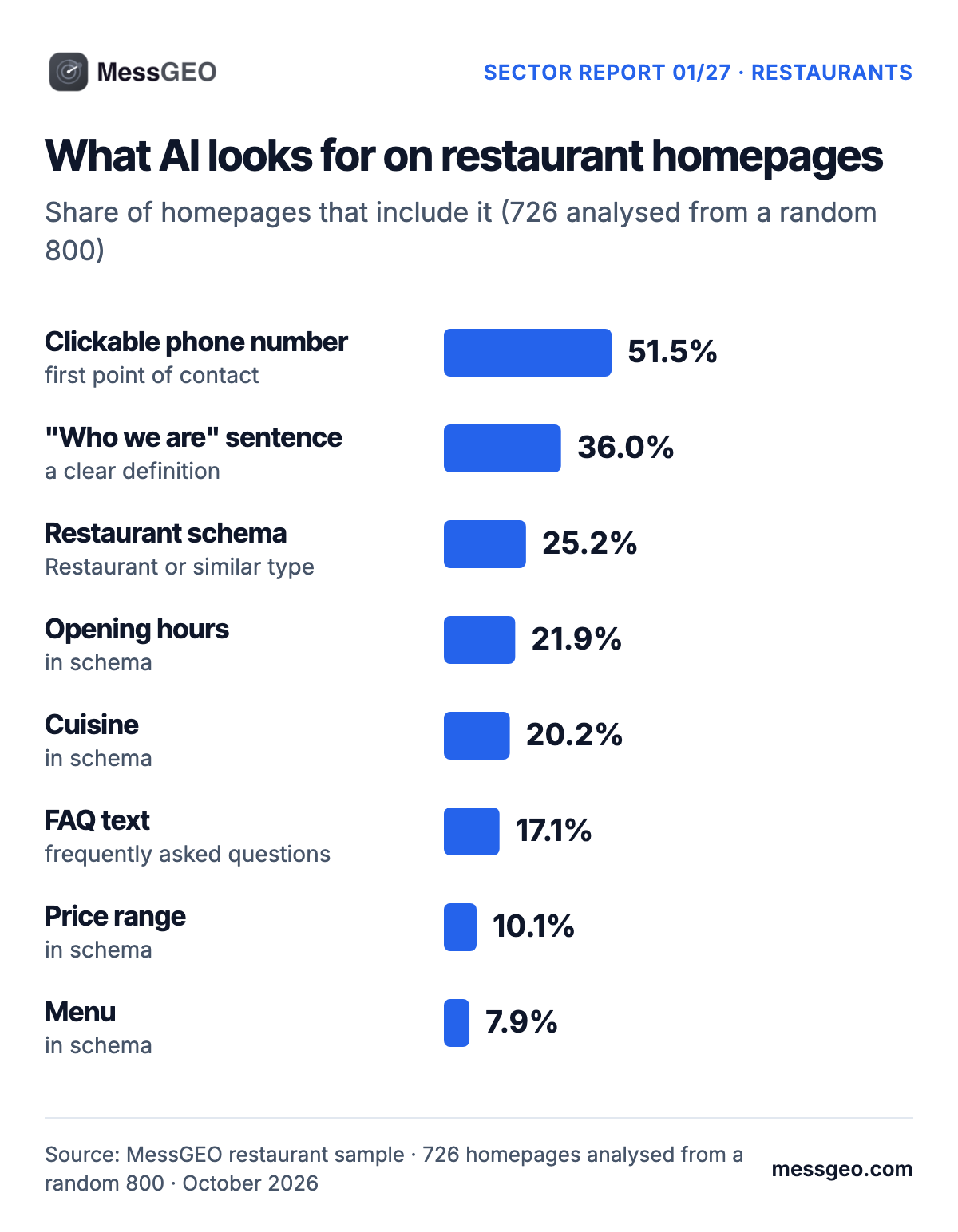
- On closer inspection (726 homepages): restaurant schema 25.2%, opening hours in schema 21.9%, menu in schema only 7.9%.
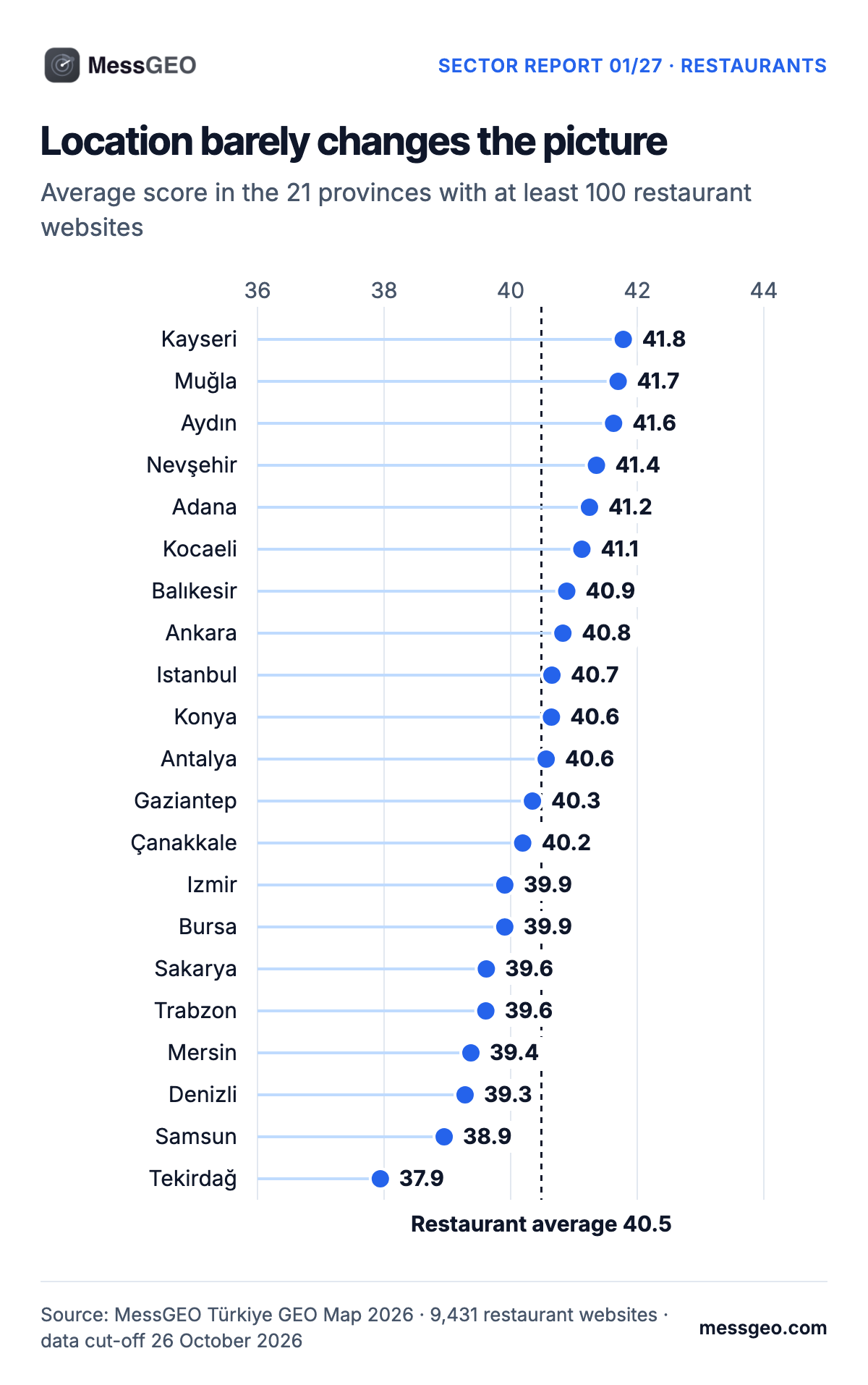
- It is not the city, it is how the website is built. Across the 21 provinces with at least 100 restaurant websites, the gap between averages is under 4 points.
This report is the first of the 27 sector reports (01/27) in the Türkiye GEO Map 2026. Next: Hotel GEO Report 2026.
Why it matters for restaurants
"Where should we go for dinner in Kadıköy?" "Can you recommend a fish restaurant in Bodrum?" Questions like these are no longer asked only of Google; people also put them to AI assistants such as ChatGPT, Gemini, Copilot, Perplexity, Google AI Overviews and Google AI Mode. The assistant names a handful of places in its answer, and a restaurant that is not named simply does not exist for that question.
Before an AI can recommend a restaurant, it has to know it: what cuisine it serves, where it is, when it is open, its price range and its menu. The restaurant's own website is the only source of this information that the business fully controls. GEO (Generative Engine Optimization) is the practice of making that information readable and trustworthy for AI.
This report does not measure whether a restaurant is currently recommended by AI. It measures whether its website provides the basics needed for that recommendation.
Where do restaurants rank among 27 sectors?
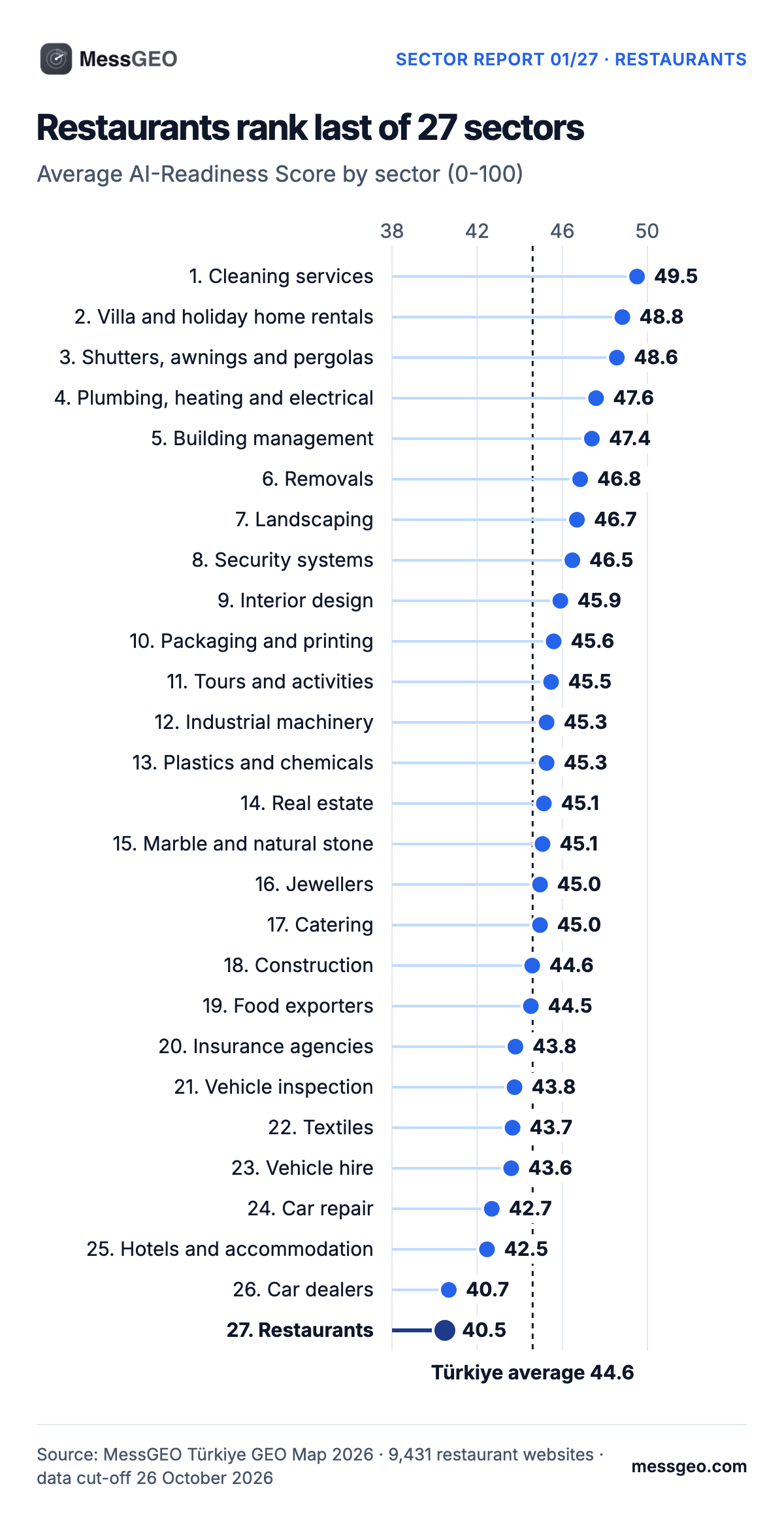
With an average of 40.5, restaurant websites sit at the very bottom of the 27 sectors analysed, 9 points behind the most AI-ready sector, cleaning services (49.5). Hotels and accommodation (42.5) and car dealers (40.7) are close to restaurants, so the sectors people often ask AI to recommend are clustered towards the bottom of the list.
89.4% of restaurant websites are "Weak" or "Critical"
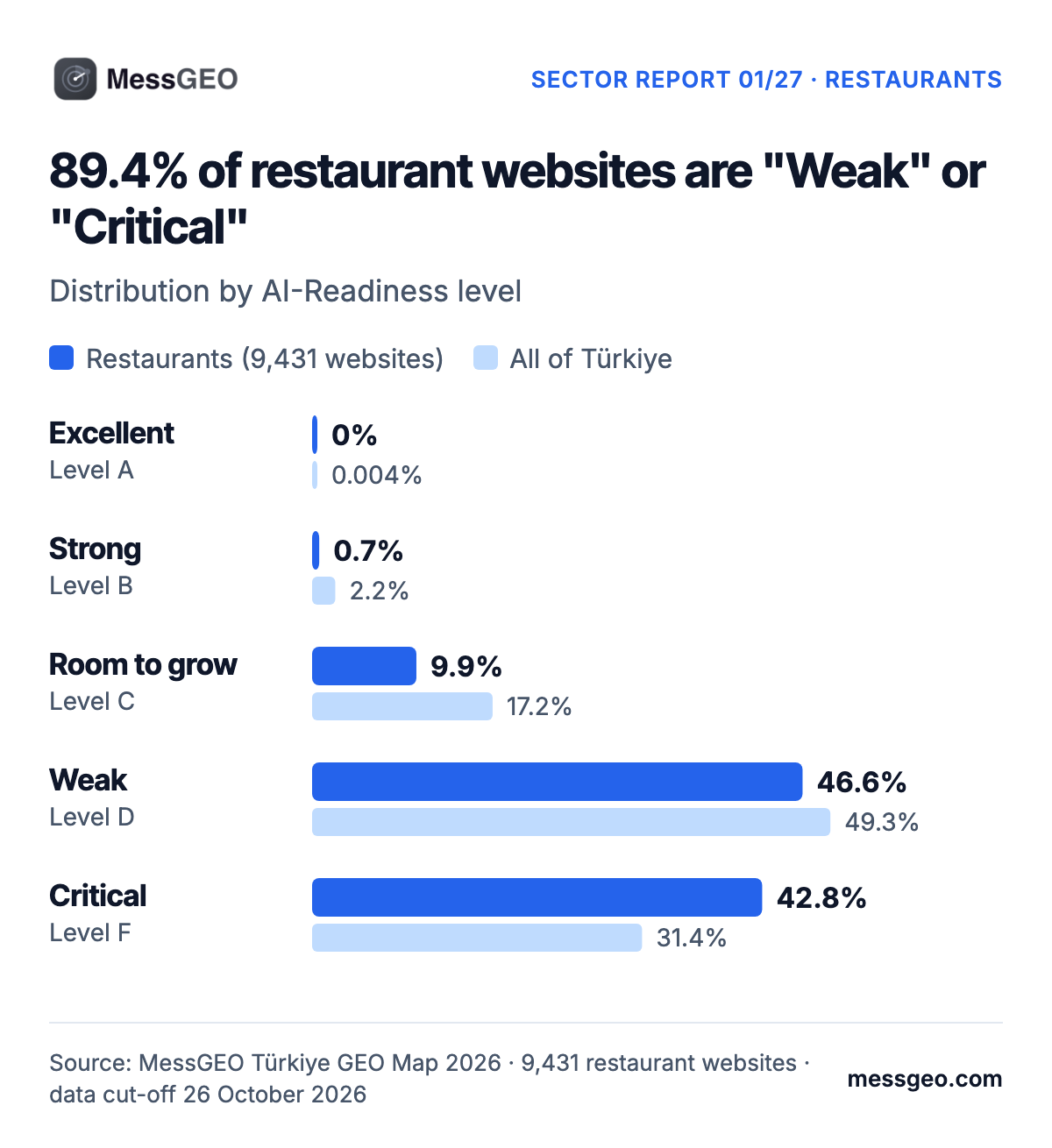
The AI-Readiness Score groups websites into five levels from A to F: A "Excellent", B "Strong", C "Room to grow", D "Weak" and F "Critical". Restaurants fare noticeably worse than the national picture:
| Level | Restaurants | All of Türkiye |
|---|---|---|
| A, Excellent | 0% (0 websites) | 0.004% |
| B, Strong | 0.7% (64 websites) | 2.2% |
| C, Room to grow | 9.9% | 17.2% |
| D, Weak | 46.6% | 49.3% |
| F, Critical | 42.8% | 31.4% |
The starkest difference is at the "Critical" level: 42.8% of restaurant websites sit there, compared with 31.4% nationally. 82.7% of restaurant websites score below 50 out of 100.
Where is the problem? The most common gap is structured data
For every website we recorded its lowest-scoring category. For 67.2% of restaurant websites, the lowest-scoring area is structured data. Structured data (schema) is a small block of code behind the page that tells AI: "this is a restaurant, here is its address, these are its opening hours, this is its cuisine." Without it, AI has to guess at this information from scattered text on the page, or may not find it at all.
Off-site authority (what other sources say about a restaurant) is only partly measured in this study, so we have left it out of this ranking.
A closer look at 726 restaurant homepages
To go beyond the overall picture, we picked 800 restaurants at random from the 9,431 websites and examined each homepage for the information an AI would want to know about a restaurant. The analysis was completed for 726 websites; the margin of error for the rates in this sample is at most ±3.7 points.
Restaurant schema, opening hours and cuisine
- Only 25.2% of homepages have restaurant-type structured data (Restaurant or a similar type).
- Opening hours appear in schema on 21.9%, cuisine on 20.2% and price range on 10.1%.
- The address appears in schema on 29.2%.
In other words, three in every four restaurant homepages do not even tell AI that they are a restaurant.
Menus: the bigger gap is not the PDF but that AI is never pointed to the menu
Restaurants are often criticised for uploading their menu as a PDF. In our sample, 3.2% of websites link to a PDF menu from their homepage (we only checked homepage links; PDFs linked from inner pages and menus uploaded as images are not covered by this check). The bigger gap lies elsewhere: only 7.9% of websites point to their menu in structured data. Even when the menu is somewhere on the site, AI is never told "the menu is here".
Text that AI can easily quote
- 64.0% of homepages lack a single clear sentence saying what the restaurant is.
- 82.9% have no frequently asked questions text, even though questions such as "Do I need to book?" or "Are there vegetarian options?" are exactly what people ask AI about restaurants.
- On 31.8%, the homepage has fewer than 300 words of text.
Can AI bots read the website?
- On 11.7% of homepages, the content is not in the page's raw HTML and only loads through code that runs in the browser. In that case some AI bots may not be able to see the content.
- 36.5% have no sitemap that we could find.
- 6.1% block AI training bots (GPTBot, ClaudeBot, Google-Extended) in their robots.txt file. In the cases we examined, this block comes from a ready-made setting of the infrastructure service the website uses, and it leaves the bots that read pages while answering (ChatGPT's search bots, PerplexityBot) untouched. So these websites are not closed to AI answers, but it is worth checking whether the setting was a deliberate choice. In addition, 3 websites (0.4%) block all bots via robots.txt.
Location barely changes the picture
Across the 21 provinces with at least 100 restaurant websites, averages range from 37.9 to 41.8, a gap of under 4 points. Istanbul (2,599 websites) averages 40.7, Ankara 40.8, Antalya 40.6 and Izmir 39.9. This range is too narrow to rank provinces meaningfully. The conclusion matches the Türkiye GEO Map: the gap is not geographic; it comes down to how websites are built.
How a website is built makes a difference
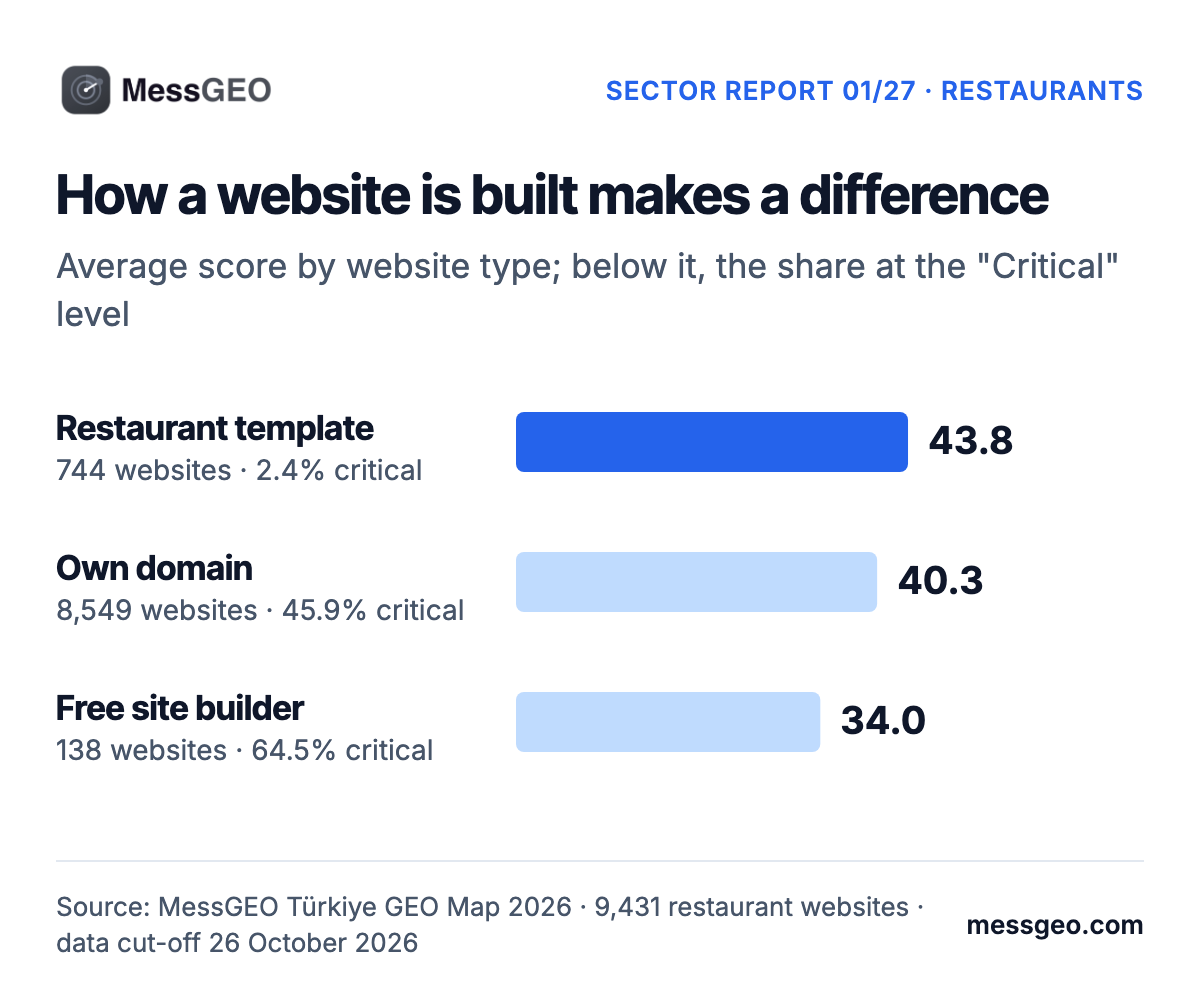
When we split restaurant websites into three groups by how they are built, the differences become clear:
| Website type | Websites | Avg. score | Share at "Critical" |
|---|---|---|---|
| Ready-made restaurant template | 744 | 43.8 | 2.4% |
| Own domain | 8,549 | 40.3 | 45.9% |
| Free site-builder subdomain | 138 | 34.0 | 64.5% |
On ready-made restaurant templates, the basics (business type, address, opening hours) usually come built into the template; on websites built from scratch, they are often left out. In our sample, every template website had restaurant schema, the address and the opening hours in schema; among the other websites, restaurant schema appeared on 17.6%. This is not a platform recommendation: restaurants that use ready-made templates may already be more digitally minded, and the groups differ greatly in size. The lesson is this: whatever you build on, make sure these basics are on your website and in your schema. MessGEO has no commercial relationship with any website platform.
A 10-point checklist for restaurant owners
- Add restaurant schema. Add Restaurant-type structured data to your website: name, address, location, phone number, opening hours, cuisine, price range, a link to your menu and whether you accept reservations.
- Publish your menu as text. Have a readable menu page with dish names, short descriptions and prices; keep PDF or image menus as an extra only. Point to the menu page in your schema too.
- Keep opening hours up to date on the page and in schema. Include public holiday and special-day exceptions.
- Write one defining sentence on your homepage. For example: "[Restaurant name] is a restaurant in [district] serving [cuisine]."
- Add a frequently asked questions section. Give short answers on reservations, parking, children's menus, vegetarian and vegan options, takeaway and capacity.
- Write your name, address and phone number the same way everywhere. Your website details should match your Google Business Profile and listings on other platforms exactly.
- Put your phone number and booking link above the fold. Make the phone number clickable.
- Make sure your content is in the raw HTML. If the page only loads through code that runs in the browser, some AI bots cannot see the content.
- Check your robots.txt and sitemap. Publish a sitemap, and review whether any blocks on AI bots are a deliberate choice.
- Do not forget what happens off your website. AI also looks at what other sources say about your restaurant; keep your details and reviews on other platforms consistent with your website.
You can check your own restaurant's website with the free AI-Readiness Score.
Methodology
- Overall picture (9,431 websites): from the Türkiye GEO Map 2026 data, the 9,431 unique websites of businesses in the restaurant category whose listed website was reachable. Restaurant websites were scanned between 3 and 8 October 2026 with the quick version of the MessGEO AI-Readiness Score (the full map ran from 28 September to 26 October 2026); data cut-off 26 October 2026. Cleaning rules and scope are the same as in the Türkiye GEO Map methodology.
- Close-up (726 websites): the homepages of 800 restaurants picked at random from the 9,431 websites were re-scanned on 29 October 2026; the analysis was completed for 726. We examined each homepage's own HTML and its robots.txt file. The 726 analysed websites average 41.1 in the overall data, while the 74 that could not be analysed average 33.0, so the sample rates may be slightly optimistic. Rates in this section come from the sample, with a margin of error of at most ±3.7 points, and should not be mixed in the same sentence with the scores from the overall picture.
- Website type: grouped by domain: subdomains of a ready-made restaurant template platform, subdomains of well-known free site builders, and all others (own domain).
- Reporting rules: province figures are shown only where at least 100 restaurant websites were analysed. No individual business is named.
- Limitations: the score measures how ready a website is for AI, not whether a restaurant is currently recommended by AI or how successful the business is. The quick scan looks at a single page of each website.
How to cite this report
MessGEO (2026). Restaurant GEO Report 2026. Türkiye GEO Map 2026, Sector Report 01/27. https://messgeo.com/blog/restaurant-geo-report-turkiye/
You are welcome to use the figures and charts in this report, provided you credit the source.
Frequently asked questions
Why doesn't ChatGPT recommend my restaurant?
There can be many reasons, but your website is the first thing to check. To recommend a restaurant, AI needs to know reliably what type of place it is, where it is, when it is open and what is on the menu. Only 25.2% of the restaurant homepages we examined have restaurant schema, and only 7.9% include menu information in schema. If this information is missing, AI struggles to recognise you.
Is it a problem to upload my menu as a PDF?
A PDF menu is not ideal for AI to read and should not be your only source. In our sample, 3.2% of websites link to a PDF menu from their homepage; the more common gap is that the menu is not mentioned in schema at all (92.1%). The best approach is to publish your menu as text and link to it in your schema.
Do I need a website if I have a Google Business Profile?
Yes. A Google Business Profile matters, but AI assistants do not rely on a single source. The detailed, verifiable version of your menu, services and frequently asked questions lives on your website, the only place fully under your control. Keeping your website details identical to your profile also builds trust.
What is Restaurant schema and how do I add it?
Restaurant schema is a block of JSON-LD code added to your page that describes your restaurant's name, address, opening hours, cuisine, price range and menu to AI in a structured way. On most website platforms it can be added with a plugin or with a few hours of a developer's time.
Which province has the most AI-ready restaurants?
There is no meaningful difference between provinces. Across the 21 provinces with at least 100 restaurant websites, averages range from 37.9 to 41.8, a gap of under 4 points. What makes the difference is not the city but how the website is built.
Does a high AI-Readiness Score mean AI will recommend my restaurant?
No. The score shows whether your website gives AI the information it needs. Whether AI actually recommends you also depends on what other sources say about you and on the competition in your area. Readiness is the first step, not a guarantee.
How can I find out my own restaurant's score?
On messgeo.com you can get a free AI-Readiness Score for any website. It shows your score, your level and the categories to fix first.