
What Is GEO? The Guide to Becoming a Brand That AI Recommends (2026)
TL;DR
Generative Engine Optimization (GEO) is the discipline of getting a brand chosen, cited and recommended inside the answers produced by AI engines such as ChatGPT, Perplexity, Gemini, Google AI Overviews and Claude. This guide's thesis, in one sentence: being readable by AI and being recommended by AI are two different things. Below we cover both, with sourced data and a framework you can actually measure.
What is GEO (Generative Engine Optimization)?
GEO is the optimization work you do to get your business recommended inside AI answers. When someone asks an AI assistant a commercial question ("which clinic should I use for a hair transplant?", "best accounting software for a small business?"), the model returns a single answer, and inside that answer it names a few businesses. GEO is the work of becoming one of those named businesses.
That work has three layers, and the rest of this guide unpacks all three in detail.
Access and readability. Can AI crawlers reach your site and understand your content? This is the on-site layer, entirely in your control.
Reputation and authority. What does the model read about you across the web: reviews, forums, directories, third-party sources? This is the off-site layer, the one you can influence but do not own. (And later in this guide we have a rather good idea for influencing exactly this. Stay with us.)
Measurement. Whether all that effort actually changes the answers users receive. This is the layer almost everyone skips.
The origin of GEO: what the Princeton KDD 2024 study found
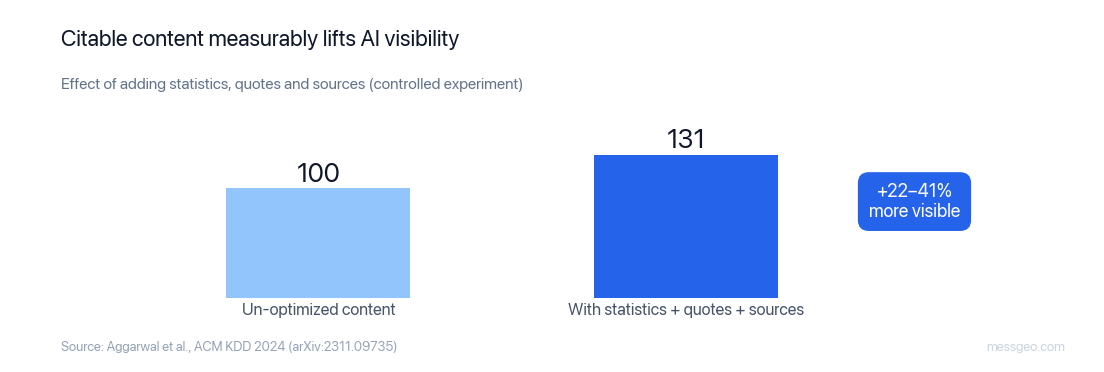
GEO is not a marketing slogan; it came out of an academic paper. Researchers from Princeton, Georgia Tech, the Allen Institute for AI and IIT Delhi published "GEO: Generative Engine Optimization" at ACM KDD 2024. In a controlled experiment across 10,000 queries, they found that adding statistics, quotations and sources to content raised its visibility in AI answers by 22% to 41%, depending on the method (Aggarwal et al., arXiv:2311.09735).
This finding is the bedrock of the whole guide, because it is the first evidence-backed answer to the question "what do you actually do to content?" A note: we wrote this article by that exact principle, so we are applying our own advice to ourselves.
GEO, AEO, AIO, LLMO: which term is right?
They are largely different names for the same thing, with some nuance. Briefly:
GEO (Generative Engine Optimization): being cited and recommended in generative engines' answers. The broadest, most inclusive term.
AEO (Answer Engine Optimization): optimization for engines that give a direct answer (featured snippets, voice assistants). Think of it as a narrower subset of GEO.
AIO / AI SEO: a catch-all "SEO for AI" label; more marketing than technical framework.
LLMO (LLM Optimization): focused on appearing in the language model's output; in practice it overlaps with GEO.
Our advice: don't get pulled into the terminology war. Your job is to show up in the AI's answer, and whether you call it GEO or AEO, the work is the same.
What GEO is not
GEO is not a hack, a guarantee machine or an overnight trick. Anyone who says "upload this file to ChatGPT and rank first" is only telling you half the story. Nor is GEO keyword stuffing; it is the opposite, producing concrete, sourced, honest content that a model can cite. And most importantly, GEO is not a one-time setup but a continuously measured process, because AI answers do not sit still (we'll prove that with data in a moment).
Is search behavior really changing? The state of play, in numbers
Yes, but not as dramatically as the headlines claim. AI inserts an "answer layer" between the user and websites, which both cuts clicks and opens a new traffic channel. Let's look at both, with sources.
Pew 2025: clicks fall from 15% to 8% when an AI overview appears
The most solid behavioral data comes from the Pew Research Center. Across 69,000 real searches, when a Google search showed an AI overview, the click-through rate on a standard result fell from 15% to 8%; clicks on a source inside the overview were just 1% (Pew Research Center, July 2025).
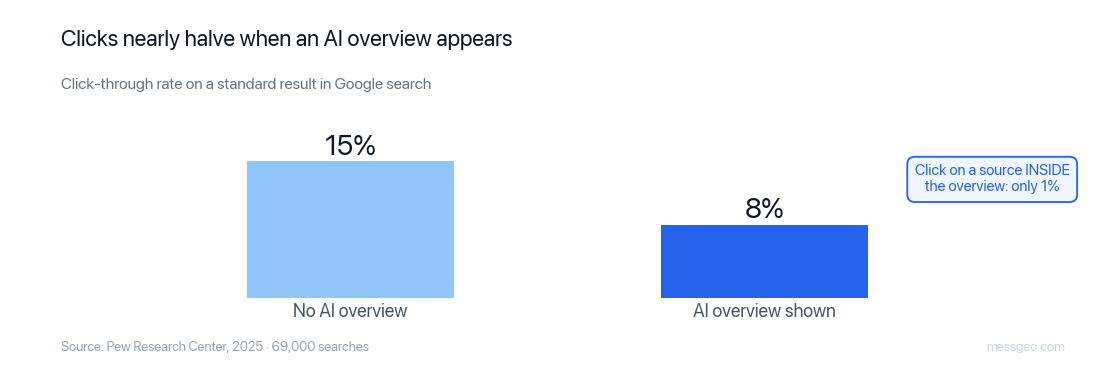
The takeaway is clear: the goal is no longer only to rank near the top, but to exist inside the answer itself. Because once users see an answer, they often click nowhere.
Gartner's 25% decline forecast, and the criticism it drew
Back in 2024, Gartner forecast that search engine volume would fall 25% by 2026 (Gartner, February 2024). But that forecast has not fully played out and drew serious criticism in the industry. Most GEO articles cite the number uncritically as proof that "search is dead." We won't. The correct reading is: search is not collapsing, it is shifting. A large share of searches still runs through classic engines today, but the direction of travel is unmistakable.
Similarweb: AI referral traffic up 357%
The flip side is opportunity. AI-driven referral traffic grew 357% in a single year (June 2024 to June 2025), and referrals to news sites grew 770% (Similarweb, 2025). Better still, this traffic is high-intent: ChatGPT referrals convert at 7.1%, behind only paid search (7.8%).
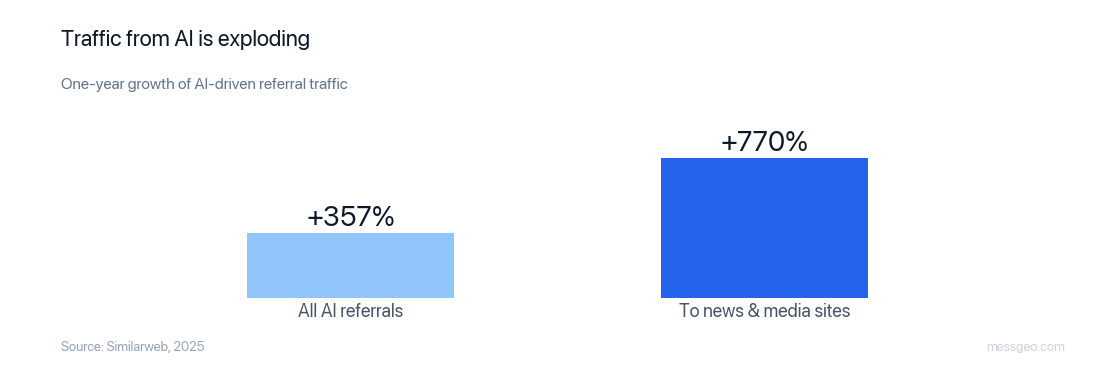
So the volume is still well below Google, Bing, Yandex and Yahoo, but the handful of visitors who do arrive are far closer to buying. That already makes GEO not a "future" project but a measurable channel today.
What this means for your business
Being early is a real advantage. GEO is still young, and most businesses have not optimized for it, so the field is wide open. Before you expect AI to recommend you, ask the more basic question: can it even find you? If you don't have a readable presence, your odds of being recommended start at zero.
Which sources do AI engines choose when they answer?
The model builds its answer from two different sources of knowledge: the "memory" from training data, and the "citations" from current sources it finds on the web. The part GEO can optimize is the citations. Any GEO work done without understanding this mechanism is a shot in the dark.
Training data vs real-time search
A model can know you in two ways. First, from its training data, if your brand appeared there enough; you can't directly control that in the short term. Second, through RAG (Retrieval-Augmented Generation), used by most modern engines: the model takes the question, searches the web for relevant sources in real time, retrieves them, and synthesizes an answer from them. This is GEO's real arena, because being "the source that gets retrieved and cited" is an optimizable goal. Put simply: the aim isn't for the model to memorize you, but to find and cite you when asked.
The most-cited sources: why are Reddit and Wikipedia ahead?
Because AI trusts the consensus of independent third parties more than any single brand's own site. In Profound's study of 30 million citations, the sources engines cite most are third-party platforms: Google AI Overviews' number-one source is Reddit (21%), ChatGPT's is Wikipedia (\~8%), and Perplexity's is, again, Reddit (Profound, 2025).
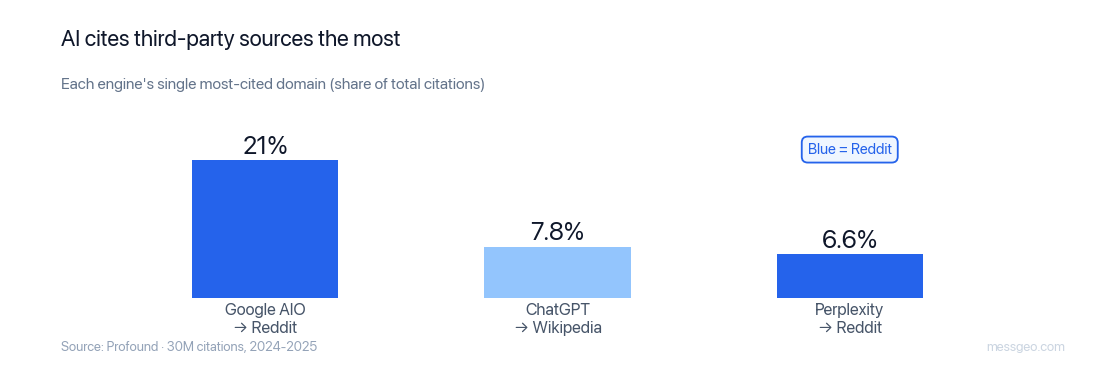
This chart already previews the core thesis we're about to reach: making your site perfect is not enough on its own unless you exist in this citation ecosystem.
Why do AI citations keep changing?
Because an AI answer is not deterministic. Ask the same question five times and you can get five different sets of recommendations. According to Semrush's AI Visibility Index, 40% to 60% of cited sources change from month to month. That single fact kills the industry's "optimize once, stay ahead forever" promise.
"We showed up in ChatGPT once" is a screenshot, not evidence. Real visibility is how often you appear when the same question is asked 20 times.
This is exactly why GEO has to be treated as ongoing measurement, not a setup; the measurement section later shows you precisely how. Put it all together and the backbone of this guide appears: being readable and being recommended are not the same thing.
What is the difference between GEO and SEO?
SEO aims to rank a page to be clicked; GEO aims to be recommended inside an answer that may never be clicked. Both use the same raw materials for a different outcome, and neither replaces the other.
The evolution of search: SEO → SGE → AI Overviews → GEO
A short chronology helps. Classic SEO tried to push one of ten results to the top. In 2023, Google began testing generative answers as "Search Generative Experience (SGE)"; in 2024 it renamed and rolled this out as AI Overviews. Note: many articles still use "SGE" as if it were live; the current term is AI Overviews. GEO is the name for the optimization discipline that covers this entire generative-answer layer, not just Google but ChatGPT, Perplexity and Gemini too.
Common ground: no GEO without solid SEO
GEO doesn't throw SEO away; it builds on it. A crawlable site, fast loading, clean information architecture, well-structured content and authority are the shared foundation of both. If AI bots can't read your site, even the best content is invisible.
Where they diverge: not ten first-page results, but one answer
The difference is clearest here:
Goal: SEO ranks a page; GEO aims to be cited in an answer.
Unit of success: in SEO, your position on a results page; in GEO, your presence and framing inside the generated answer.
User action: in SEO they click your link; in GEO they may act without clicking at all.
What the machine reads: in SEO, the rendered page; in GEO, the raw HTML and off-site signals.
Result stability: in SEO, a rank is relatively stable; in GEO, the answer can change on every ask.
Measurement: in SEO, rank trackers and Search Console; in GEO, repeated prompts across engines and regions.
Will GEO replace SEO?
No. SEO is still the biggest channel for clicks and conversions; Google's referral volume dwarfs that of AI platforms. GEO isn't a replacement for SEO but a new front that complements it. The right question isn't "which one" but "how do I run both on one budget", and the good news is that much of the same foundational work serves both at once.
Being readable ≠ being recommended: GEO's two separate fronts
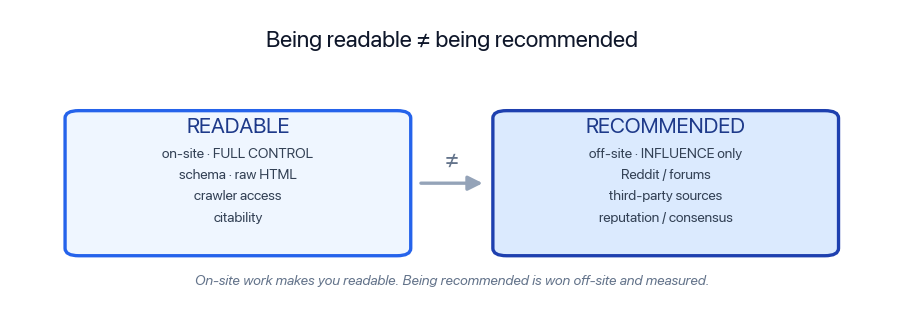
GEO has two fronts, and most guides mislead you by lumping them together. One front is entirely in your control (readability); the other you can only influence (recommendation). Your visibility depends on both working together.
On-site work makes you readable. It does not make you recommended. Recommendation is won largely off-site, and it is always measured.
The on-site front: control is entirely yours
This front is fast, cheap and completely in your hands: technical access, raw-HTML content, structured data, entity clarity and citable passages. Do these well and you become a candidate the model can understand and cite. Measuring the state of this front is called a leading indicator; MessGeo's AI-Readiness Score does exactly that, gauging how readable your site is today.
The off-site front: recommendation comes largely from authority
In competitive commercial questions, what decides the recommendation is often not your site but the web's consensus about you; the Reddit and Wikipedia dominance we just saw in the Profound data is the proof. You can't config-file this front, but you can shape it: independent sources corroborating you, a real presence in forums, being cited in industry publications. It's slow and it compounds; this is GEO's real game, and we devote one of the longest sections of the guide to it.
Why popular GEO advice falls short
Because most guides describe only the on-site front and sell the illusion that "fix your site and you'll be recommended." That's a half-truth. The complaint "my site is technically perfect but ChatGPT still doesn't recommend me" comes from exactly this: the on-site front is done, the off-site front never started.
The GEO equivalent of E-E-A-T: trust signals split across two fronts
Google's quality framework E-E-A-T (Experience, Expertise, Authoritativeness, Trust) is in fact a direct map of our two-front thesis. Experience and Expertise are proven largely on-site: author identity, first-hand experience, in-depth content. Authoritativeness and Trust are earned largely off-site: others mentioning you, independent sources corroborating you. So don't treat E-E-A-T as a separate checklist, but as trust signals split across two fronts; that view makes clear which signal is won on which front.
How to do GEO, front 1: on-site optimization
Make your content and technical infrastructure easy for AI to read and cite. This entire front is in your control, and you can cover real ground in a weekend. To see where to start, running an AI-Readiness Score on your site shows, at a glance, where you stand on every point below.
Answer-first content: let each section answer in its first sentence
When AI builds an answer, it doesn't lift a whole paragraph from a page; it lifts the single passage that directly answers its question. So the first sentence under each heading should be a self-contained answer to that heading. Compare:
Weak: "Hair transplant pricing is a broad topic shaped by many factors and much discussed in recent years."
Strong: "Three main factors set a hair transplant's price: graft count, clinic experience and city."
The second is directly citable; the first is noise to the model.
Adding statistics, quotations and sources
This is the proven most-effective on-site tactic. Princeton's study showed that adding statistics, quotations and sources lifts visibility by 22% to 41% (arXiv:2311.09735). The logic is simple: models prefer verifiable, sourced claims, because those carry a "trustworthy" signal.
In practice: attach a number and a source to every important claim. Instead of "many happy patients", write "1,240 procedures in the last 12 months, average satisfaction 4.7/5".
Heading hierarchy and chunkable content
AI splits your content into meaningful "chunks", and a clean H1 → H2 → H3 hierarchy makes that easier. Write short, single-topic sections rather than long, sprawling paragraphs. A good heading should say, on its own, what its content is, a roadmap for both reader and model.
Structured data: Schema, FAQPage, Organization
Structured data (schema.org) tells the machine plainly what your page is about. The most valuable for GEO are Article, Organization, FAQPage and BreadcrumbList. Schema alone won't make you recommended, but by ensuring your content is understood correctly it strengthens the readability front.
FAQPage markup, step by step
Mark up the question-answer blocks on your page with FAQPage schema. The basic skeleton:
{
  "@context": "https://schema.org",
  "@type": "FAQPage",
  "mainEntity": [{
    "@type": "Question",
    "name": "What is GEO?",
    "acceptedAnswer": {
      "@type": "Answer",
      "text": "GEO is the practice of getting your brand recommended in AI answers."
    }
  }]
}
Each question is a Question, each answer an acceptedAnswer. The FAQ section of this guide is marked up exactly this way.
The most common schema mistakes
Three typical errors: (1) marking up content that isn't visible on the page (a violation), (2) using the wrong type (calling a list page an Article), (3) adding schema and never testing it. Check every change with a validation tool.
Technical access: can AI bots read your site?
Check this first, because everything you do while bots are blocked is wasted. AI crawlers generally don't run JavaScript; they read raw HTML. If your content only appears after render, it may be invisible to them.
Try our AI Bot Access tool for free.
GPTBot, ClaudeBot, PerplexityBot in robots.txt
Make a deliberate decision about these bots' access to your site. If you want to appear, make sure you're not blocking them; if you want to keep certain bots out, say so explicitly. Plenty of sites block every AI bot by accident and have no idea.
What llms.txt does and doesn't do
Honest assessment: llms.txt is a new proposal meant to hand AI a map of your content; it does no harm and can be added as a hygiene step. But today it is not a proven "ranking factor"; be skeptical of anyone selling it as a growth lever. Add it, but don't attribute miracles to it.
Try our llms.txt auditor and validator tool. MessGeo gives you a wealth of free data for the on-site GEO work you do.
How to do GEO, front 2: off-site authority
Build an independent, trusted presence across the web, beyond your own site. This front, which rivals cover in a paragraph or two, is the real answer to "my site is perfect but AI doesn't recommend me."
Why brand mentions are becoming more valuable than backlinks
In classic SEO, links were king. In GEO, being mentioned (even without a link) is increasingly decisive. Because AI can read contextual mentions in text, the sentence "clinic X stands out for hair transplants" in a trusted industry article can be a stronger signal than a bare backlink. The goal: your name appearing in the right context, in the right places.
Existing on Reddit, Wikipedia and forums, with ethical limits
The Profound data showed Reddit and Wikipedia's dominance, so existing there makes sense. But the line is clear: fake accounts praising your own brand (astroturfing) may seem to work short-term, but platforms detect and punish it, and it backfires into reputation damage. The right path is genuine contribution: answering questions, disclosed participation, genuinely useful content. Wikipedia's bar is even higher; you belong there only as an independent, sourced, notable entity.
Digital PR and producing citable original data
The most sustainable off-site tactic is to produce original data that others are compelled to cite. An industry report, a survey, a first-of-its-kind measurement: these carry news value and are exactly the kind of content AI surfaces as a "source". Producing citable, verifiable, original data is one of the strongest and most durable GEO moves you can make.
Your market's citation ecosystem: forums, local news, industry associations
AI leans on different sources depending on market and language. When it answers, it frequently draws on forums, local and national news outlets, industry associations and professional bodies. Building off-site authority means having a genuine, positive presence in the specific citation sources your audience's answers actually draw from. Map that ecosystem for your market and show up in it.
GEO engine by engine: ChatGPT, Gemini, Perplexity, Claude, Google AI Overviews
Each engine chooses sources differently, so your optimization priority changes by engine. Regularly tracking where you stand in each engine (that is, doing prompt tracking) turns this section from abstract knowledge into concrete action.
How do you get recommended in ChatGPT?
ChatGPT retrieves current web sources when search is on and relies on training data when it's off. Since it leans most on authority sources like Wikipedia, a correct and sourced presence there is critical. Action: make sure your brand appears clearly and consistently across trusted third parties.
How do you appear in Google AI Overviews?
AI Overviews draws largely from Google's own search results, so solid classic SEO directly helps here. Given Reddit's dominance in this engine (21%), a genuine presence in relevant Reddit discussions is extra valuable. Action: be organically strong on your target queries and back it with structured data.
Perplexity: the difference of a source-showing engine
Perplexity backs every claim with numbered sources; it's the most transparent engine for GEO, because you can see exactly which source was chosen. Citable, sourced, clear content is rewarded most here. Action: produce answer-first, well-sourced content, and observe directly why Perplexity does or doesn't pick you.
Gemini and the Google ecosystem
Gemini is wired into Google's search and knowledge-graph ecosystem; the accuracy of your business information (Google Business Profile, consistent NAP) shows up here. Action: keep your entity clarity and your Google-ecosystem information current.
MessGeo's Prompt Tracking includes an Opportunities section that surfaces, for the prompts you care about, the openings where you could appear.
How is GEO success measured? Leading and lagging indicators
Not with a single screenshot. GEO has to be measured with two kinds of indicator: the leading indicator that tells you whether your site is ready, and the lagging indicator that tells you what AI actually says. This is the distinction most guides and tools skip, and MessGeo was built specifically to measure both.
Leading indicator: the AI-Readiness Score
The leading indicator measures how readable and citable your site is today, the state of the on-site front you control. MessGeo's AI-Readiness Score does this: it scans dozens of items such as schema, raw-HTML access, entity clarity and citability, and returns a score out of 100 plus a concrete to-do list. Why "leading"? Because improving this score is a precondition for future visibility, not a guarantee of it. You get the readability ticket; it doesn't guarantee that you'll appear in the answers.
Lagging indicator: Prompt Tracking
The lagging indicator tells you the truth: do the engines actually mention you? MessGeo's Prompt Tracking asks the questions that matter to you (for example, "the best hair transplant clinic") across engines like ChatGPT, Perplexity and Gemini, regularly and repeatedly, and reports which queries you appear in, how often, alongside which competitors, and how the trend moves over time. This is the only true outcome metric, because however much you improve the leading indicator, the real question is "are you in the AI answer?". The Opportunities section in the tool also surfaces the openings tied to your prompts, the doors you could walk through (forums where you can post, Reddit pages showing in the rankings, and so on).
Set up Prompt Tracking: monitor your position across the prompts you enter, and see the list of ranking opportunities on the prompts that matter to you.
Manual prompt tracking: a free, 30-minute method
You can start without any tool, and our honest advice is to try it manually first. The method:
- Write 15-20 real questions about your business (the way your customer would ask AI).
- Ask them in ChatGPT, Perplexity and Gemini. Repeat each 3-5 times to see the variability.
- Record, in a table, whether your brand is mentioned and which competitors show up.
- Repeat monthly and watch the trend.
This manual method gives you a free baseline. When you want to scale it, tracking many queries across many engines and regions automatically and repeatably, Prompt Tracking takes over; but starting manually first helps you understand what you're measuring.
GEO measurement and analytics tools
When choosing a tool, ask one question: does this tool measure the leading indicator (site readiness) or the lagging indicator (real AI answers)? They're different jobs, and most tools do only one. By that same criterion, the landscape, competitors included:
Leading-indicator-heavy (site readiness): various technical audit and schema tools; they look at your readability, not real AI answers.
Lagging-indicator-heavy (AI visibility): tools like Profound, Otterly.AI, Peec AI and the Semrush AI Toolkit; they track what engines say, but most don't audit on-site readiness.
Both: MessGeo aims to close the loop by offering the AI-Readiness Score (leading) and Prompt Tracking (lagging), improve, re-measure, see the difference.
Whichever you choose, keep the principle: a setup that doesn't track both indicators is a half-measurement.
MessGeo brings together more than 10 dedicated GEO tools under one roof.
Which metrics to trust and which not to
Don't trust: a one-off screenshot, a "we appeared once" claim, or an unsourced "we're number one in AI".
Trust: an appearance rate from repeated measurement, the trend over time, and share of voice versus competitors. It's the curve that matters, not the snapshot.
Where the biggest GEO opportunity is right now
Being early pays off disproportionately. GEO is still new, most businesses haven't optimized for it, and in less-saturated languages and markets the citation pool is thin, which means a well-executed, relatively small investment can win visibility that would be impossible in the most crowded English-language niches. The businesses that move first fill that gap.
The priority order shifts by sector. In health and medical travel, the buyer is often abroad and asks in English, so bilingual content and international reputation come first. In e-commerce, product-comparison queries and structured product data are decisive. In local services (clinics, restaurants, consultancies), the Google ecosystem, local directories and consistent business information are critical. Every sector applies the same GEO principles in a different order of priority.
The limits of GEO: what can no one guarantee you?
No one can guarantee first place in AI, and anyone who does is either uninformed or misleading you. This section, with a rare honesty for the industry, explains what isn't possible, because knowing what you'll get is the precondition for choosing the right supplier.
Why "guaranteed number one in AI" can't be promised
Three technical reasons: AI output is not deterministic (the same question yields different answers), results are personalized and localized (they change by user and location), and recommendation is probabilistic (you raise the odds, not a guarantee). Together, these make a "permanent number one" technically impossible.
Variability isn't a bug, it's the nature of the system
Recall the Semrush data: 40-60% of citations change month to month. That's not a malfunction but the nature of generative systems. So the right expectation isn't "win once, stay forever" but "measure continuously, keep the trend up". GEO isn't a target, it's maintenance.
5 questions to ask when buying a GEO service
When buying a GEO service from an agency or tool, ask:
- How do you measure results, a single screenshot or repeated measurement?
- Do you track the leading indicator, the lagging one, or both?
- What do you guarantee, and what don't you?
- Are your sources verifiable?
- Do you measure a baseline before the work starts?
Steer clear of any supplier that can't answer these clearly and honestly.
A 90-day GEO roadmap
First measure, then become readable, then build reputation, and keep measuring throughout. Here's the whole guide distilled into an actionable plan.
Days 1-30: measure and fix
Take a baseline: run your site's AI-Readiness Score and record, with manual prompt tracking, whether AI mentions you today. Then fix technical access (bot access, raw HTML, basic schema). This is the "know where you stand" month.
Days 31-60: answer-first content
Produce content that matches the real questions surfaced in your manual tracking; each one answer-first, sourced and marked up with schema. Apply the Princeton principle: add statistics, quotations and sources.
Days 61-90: off-site authority and re-measurement
Move to the off-site front: build a genuine presence in your citation ecosystem (local news, industry associations, relevant forums), and try producing and distributing an original piece of data. At month's end, re-measure the baseline; with Prompt Tracking, make your first real trend comparison. Now you're looking at a curve, not a snapshot.
GEO glossary: key terms
GEO (Generative Engine Optimization): the discipline of getting a brand chosen, cited and recommended in the answers of AI engines. It replaces SEO's ranking goal with the goal of appearing inside the answer.
LLM (Large Language Model): the AI model behind tools like ChatGPT, Gemini and Claude, trained on vast amounts of text. It understands questions and generates answers in natural language.
RAG (Retrieval-Augmented Generation): the method by which a model, when answering, draws not only on its memory but on current sources it retrieves from the web. This is the main mechanism GEO optimizes.
Grounding: basing a model's answer on verifiable sources. Well-grounded answers show the sources they cite.
Citation: the AI linking a piece of information in its answer to a specific source. GEO's core currency; the aim is to be the cited source.
AI Overview: the generative summary Google shows above search results. The rolled-out form of the 2023 "SGE" experiment.
Entity: a specific person, brand or concept the AI recognizes and accumulates information about. "Entity clarity" is your brand being consistently understood by machines.
Chunk: the meaningful unit of text into which AI splits your content. Clear headings and short sections make correct chunking easier.
Hallucination: the model confidently producing false information. The GEO risk: the model may state something wrong about your brand; a clear, sourced presence reduces it.
Token: the smallest unit in which a model processes text (roughly a word fragment). "Token-friendly content" is clear, concise content a model can process efficiently.
Prompt: the question or command a user gives the AI. In GEO, "prompt tracking" means monitoring your visibility on target questions.
Vector search: search based on semantic proximity rather than exact word matching. It underlies modern AI search systems.
Share of Voice: how often your brand is mentioned versus competitors across a set of questions in AI answers. GEO's competitive success metric.
Frequently asked questions
What is GEO, in short?
GEO is the practice of getting your brand recommended in AI answers such as ChatGPT, Perplexity, Claude, Copilot and Google AI Overviews. Where SEO ranks you, GEO places you inside the answer.
How long does GEO take to show results?
On-site readability improvements are measurable within weeks; off-site authority and real visibility change over months. Honest expectation: this isn't a campaign but a discipline that requires continuity.
How much does GEO cost?
You can start free or cheap with a baseline measurement and basic on-site fixes. The real cost is in continuous content production, off-site authority work and regular measurement, that is, time and effort.
Can small businesses do GEO?
Yes, and the content gap in less-saturated markets and languages is an advantage for smaller players. In a low-competition citation pool, a well-executed, modest investment can bring outsized visibility.
Why doesn't my brand appear in ChatGPT?
The most common reason is that you finished the on-site front and never started the off-site one. AI builds recommendations largely from third-party sources (Reddit, Wikipedia, news sites); if you're absent there, you may go unmentioned even with a flawless site.
Can I measure GEO myself?
Yes. You can start free by asking 15-20 real questions across ChatGPT, Perplexity and Gemini repeatedly and recording whether your brand is mentioned. For scaled, automated tracking, tools like Prompt Tracking come in.
Is llms.txt mandatory?
No. llms.txt is a harmless hygiene step but not a proven ranking factor today. You can add it, but be skeptical of claims that it alone brings visibility.
Can my SEO agency also do GEO?
Partly. Solid SEO is GEO's foundation, but GEO also requires off-site authority and engine-level measurement. Ask your agency "how do you measure AI answers?"; if there's no clear answer, the GEO side is missing.
Will AI traffic replace Google traffic?
Not yet. In volume, AI referrals are far below Google, Bing, Yandex and Yahoo. But this traffic is high-intent and growing fast (+357%), so it's a complementary and increasingly valuable channel.
Conclusion: measure first, then optimize
AI is permanently changing how your business gets found. It's no longer only about ranking, but about being recommended inside the answer. The path runs through three steps: become readable, build off-site reputation, and above all measure the outcome continuously, not with a single screenshot. In GEO the winner isn't the one who promises the most, but the one who speaks measurably. Be on the side that shows evidence, not the side that guarantees.
Wondering how ready your site is for AI? Start with a free AI-Readiness Score, no card required, results in minutes.
How this article was made. We practice what we sell. This guide was built with the principles we recommend to clients: each section opens answer-first, every claim is sourced or original, comparisons are clear, and the FAQ is schema-ready. We applied Princeton's finding (sourced content is more visible) to the article itself.
Want to measure this on your site?
Enter a URL, get a deterministic 0-100 score across 10 weighted categories - with a why-it's-low, how-to-fix note and evidence on every finding.
AI-Readiness Score